


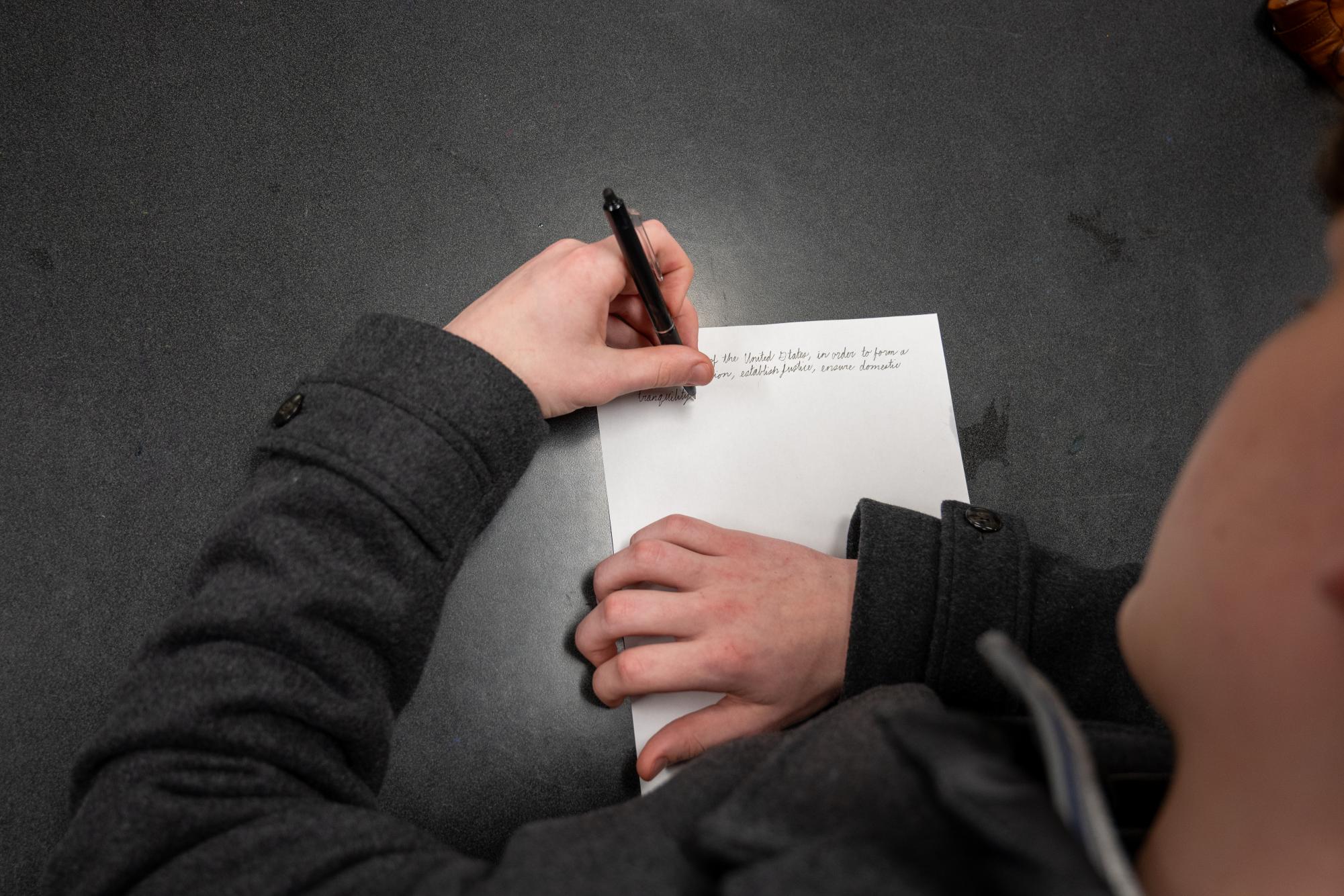
A close-up of sophomore Derek Heyworth-Davis’ handwriting looks almost cinematic. The pen barely lifts, and the letters lean into one another with a smooth and somewhat medieval confidence. In most classrooms now, writing is fractured into taps, clicks and the frantic swivel of a cursor. The flowing lines of cursive that were once required in classrooms have now dwindled into a few, like Heyworth-Davis’s.
Heyworth Davis was taught cursive in first grade, but when he entered middle school, cursive stopped being mandatory. Yet, Heyworth-Davis still preferred writing in cursive.
“By that point, I had simply forgotten how to effectively write in manuscript,” Hayworth-Davis said. “So it became better to write in cursive entirely.
At the elementary and middle school, Park Maitland, cursive is still taught as a formal skill, a language arts teacher, Becky Austin, says is both intentional and researched.
“There are many reasons why using cursive is so important,” Austin said. “Cursive writing is good for students who have learning disabilities such as dyslexia or dysgraphia.”
Research supports that claim. According to a 2014 PBS NewsHour report by Elizabeth Jones, language specialist Marilyn Zecher said cursive helps students with dyslexia by integrating hand-eye coordination, fine motor skills and memory. Zechor said functional magnetic resonance imaging (fMRI) studies show that involving the hand creates stronger associations for learning and recall, allowing students to decode letters and sounds.
For students who continue writing by hand into middle and high school, speed and flow matter.
“Every time you have to pick up your pencil, it’s like you have to restart,” Austin said. “So if you learn how to write in cursive, you will actually be able to take notes quicker when you go into high school and into college.”
Not all students experience cursive with the same ease. Vaishnavi Ghanti, a sixth grader, learned cursive in the third grade but said it never fully stuck. She prefers to type out of convenience.
“I kind of got the hang of reading (cursive), but never really got a chance to actually get good at writing it,” Ghanti said.
Ghanti’s preference for typing reflects a growing divide in how students approach writing — between efficiency on one hand, and the tactile experience of using the pen on the other.
“Print feels much slower for me,” Heyworth- Davis said. “It feels almost mechanical and brutish, whereas cursive is much more elegant to write because it’s all swooping gestures.”
Spanish Teacher Rita Daugherty chose to teach calligraphy after years of using it for certificates, invitations and cards, “People have always been kind of astonished,” Daugherty said. “They’re like, ‘Oh wow, you know how to do that?’”
The astonishment, Daugherty said, reflects how unusual handwriting has become. “A lot of kids don’t know cursive, and then they print, and when they’re taking notes, it’s so tedious for them,” Daugherty said. “Writing doesn’t have to be such a chore.”
Austin said she notices impatience in the classroom. “Students with technology want instant gratification,” she said. “Sometimes they need to learn to slow down because writing is kind of an art.”
Despite its decline after being taken out of Florida public school curricula in 2010, cursive still serves everyday purposes. Heyworth-Davis said being able to read it has proven unexpectedly useful, particularly when encountering handwritten notes or older documents.
Daugherty said handwriting carries a personal charm that typing just can’t replicate. “Your handwriting is unique. It’s part of your personality.” Daugherty said.
Heyworth-Davis agreed that cursive is not a necessity, but still defended its value. “It’s not the kind of thing that they will die regretting,” he said. “But it’s a good skill to obtain.”
For now, cursive exists in pieces—licenses earned in third grade, swooping signatures, points marked off on an essay. It appears wherever effort is visible, where handwriting becomes proof that someone stayed with a thought long enough to shape it.
“When somebody makes something by hand, it’s their time, it’s their talent,” Daugherty said. “And I think people appreciate it more.”