

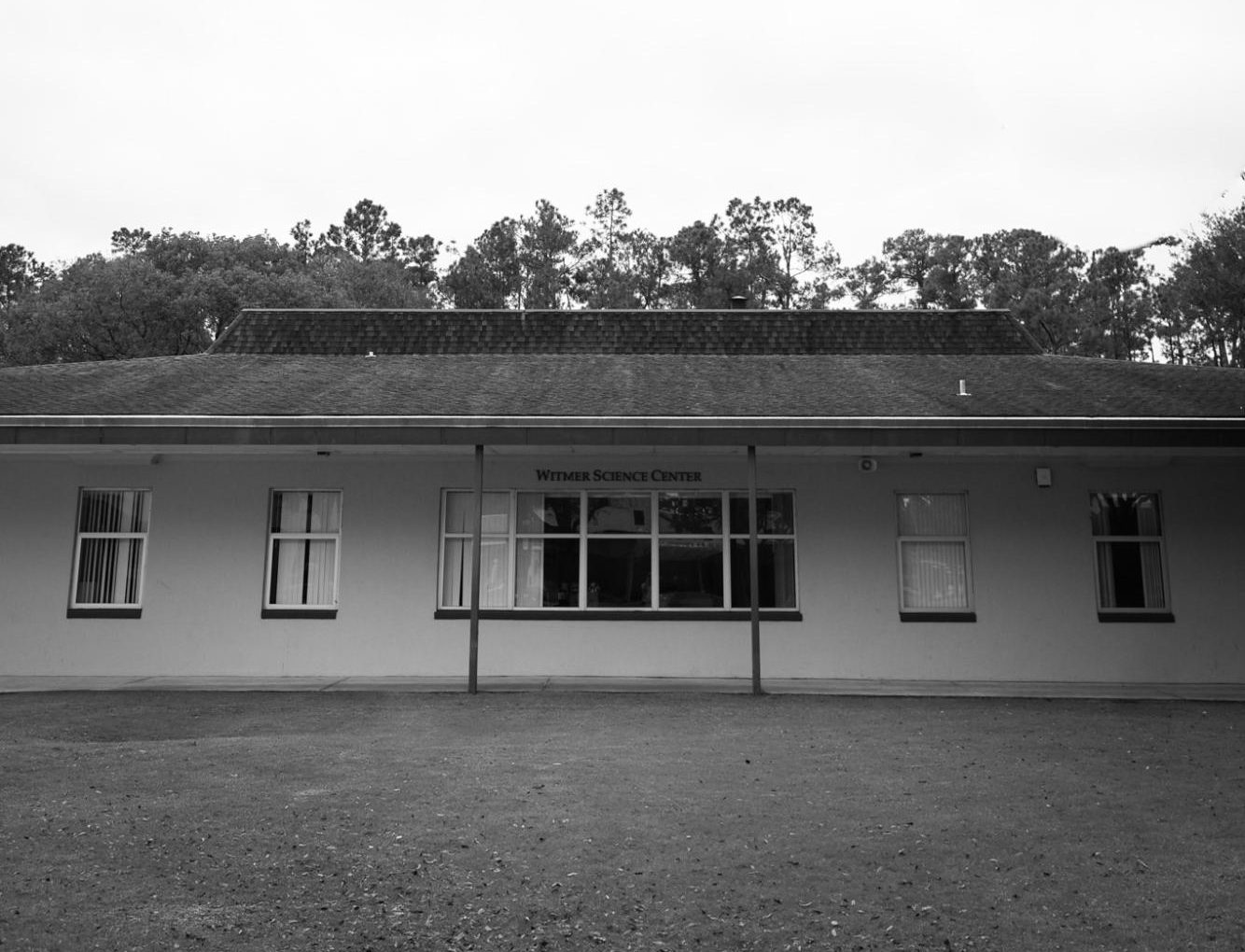

In October, science and math classes transitioned into the Nochur Sankar Science Center, leaving Witmer void of any students and Stuart at a reduced capacity. Classes went from fully decorated and lived-in classrooms to the new building with a minimalist vibe and modern aesthetic.
“It’s a bit of an adjustment, because you have to figure out where to go, and then your teachers move around after class,” senior Annalyce Campbell said. “You cannot find them in the same place.”
Part of the move to the new building entails teachers no longer having their own classrooms, instead rotating between classes and sharing with other teachers. While this can be hard for students, it is an emerging approach adopted by many schools.
“We have moved into a nonhome base, not having your own classroom,” Associate Head of School Dennis Herron said. “We built the faculty lounge to have a place where teachers could store their valuables, lockers, space, desk space (and) working space. There’s a shared kind of planning space that is different than before, which means you cannot decorate a classroom like it’s your own home.”
The shift toward the shared classrooms and away from individual “home bases” is to create a more focused environment without the distraction of classroom decorations, a goal backed by research. According to the website Science and Education, kids spend more time looking at decorations on the walls than at the teacher lecturing. One study found that students in classrooms with no decorations scored higher than those in classrooms with decorations. A new building comes with new rules such as locked doors. In the older buildings, all classroom doors were unlocked; students had access anytime throughout the day. In Sankar, students have to wait for someone on the inside to open the door for them.
“It’s hard when the doors (are) locked all the time because the teacher could be teaching, and then someone’s at the door and they keep having to stop to let people in,” sophomore Noyan Tekin said.
While the locking doors were implemented for safety, they have become a slight issue.
“The door being locked all the time is a struggle,” Herron said. “It was really hard at first, and we can’t prop it open because the doors are locked for a reason. It’s a safety feature.”
In order to preserve the cleanliness of the building and the safety of the laboratory spaces, food and drinks are also banned.
“I miss the old (building) because I liked being able to eat a snack during class,” Tekin said.
After all of these changes, some students love the new building, while others reminisce about the buildings they used to be in every day.
“I like the old buildings better,” Campbell said. “(They are) a little bit cozier (and) more lived in than the new building.”
Leaving behind the old buildings can be difficult because of how long they have been around, with most of the student body having at least one class in one of them. But there is a new sense of fondness that comes from the new building.
“There is a certain level of spirit or pride that you take, if you’re a student walking into that building,” Herron said. “That’s a lot different than when you walk into Witmer.”
Plans have circulated that these buildings will turn into something greater. A board committee is focusing on the next steps for Witmer and Stuart. While there are possible ideas of a Grille expansion, new classrooms or an addition of athletic space, nothing has been confirmed yet.
“Dining space, some athletic space, potentially,” Herron said. “There is going to be space that is renovated, built new or torn
down, likely in this area.”