

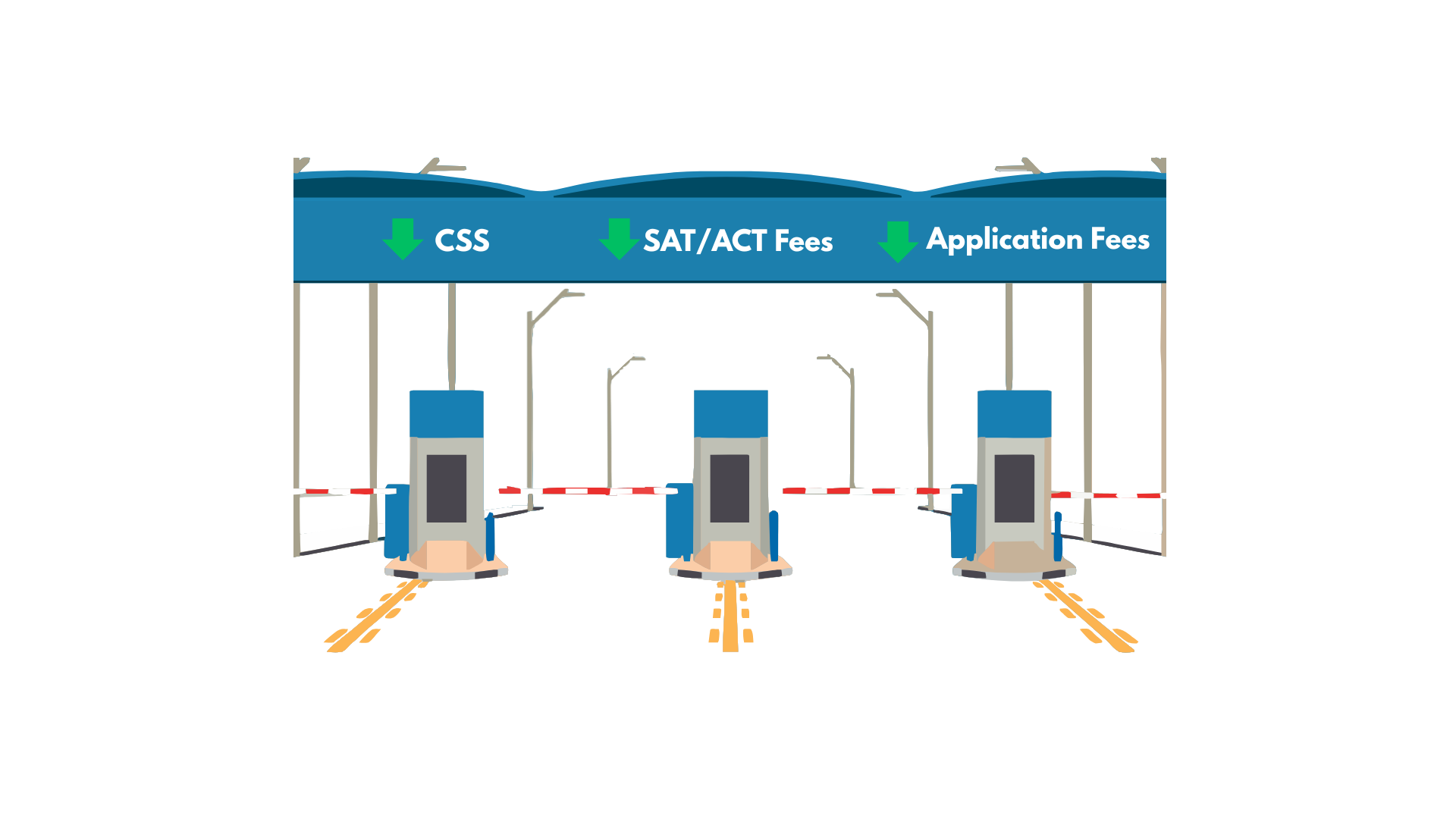

Ninety dollars goes a long way in this economy. That could be roughly 26 dozen eggs, or an oil change with money to spare or two bottles of Dior Backstage foundation. For millions of students, it is also one single application to Stanford. That $90 adds up when students apply to more and more colleges of comparable application cost. As a nation that praises higher education as the great equalizer, it would be ironic to accept a process that is riddled with financial barriers that render the process unfair.
The College Board suggests that students apply to five to eight colleges. At a school of overachievers, though, it can be a bit more.
“I haven’t fully applied to 20 (colleges) right now, but I’m planning to,” senior Hannah Wang said. “I’ve applied to Florida schools and then my early school, but my goal right now is around 20.”
While it may be particularly common at Trinity due to pressure from both parents and peers, our student body is not the outlier in this practice. Applying to more than seven colleges is an increasingly common occurrence, with at least 36% of prospective students applying to seven or more colleges as per the Higher Education Research Institute in 2017. Moreover, at a school like Trinity, where students are applying to top colleges where application costs can range from $65 to $90, costs add up incredibly quickly.
In addition to application costs, with colleges rolling back test-optional applications, most students opt in to taking either the SAT or the ACT. The College Board says that students should take the SAT two to three times.
If a student does the bare minimum, taking the SAT twice would cost a student $136. Students must then send those scores to their five colleges, costing $75. Finally, applying to five state schools, say the University of Florida, University of South Florida, Florida State University, University of South Florida and University of Miami, would cost a student $195. If a student follows the recommended guidelines for college applications and nothing more, the cost would still be $406. However, in a school where students are applying to upwards of 15 colleges, the costs quickly exceed thousands of dollars.
“Talking to my friends who go to Winter Park or some other public schools … a lot of people don’t want to apply to a lot of schools specifically because of the financial attribute, not because they think they won’t get it or it’s difficult or the effort involved,” Wang said.
Simply put, college application fees are stifling students’ chances of attending their desired college before a reader ever receives their application. Importantly, all of these costs are felt most acutely by the students who need the most help.
In an attempt to avoid deterring prospective students, fee waivers are offered. While fee waivers allow students to apply for no cost, the qualifications for fee waivers are ultimately still not doing enough to aid students in need. For example, 22 million students nationally are eligible for Free Lunch Programs, which themselves are used as a proxy to see if students qualify for a fee waiver. Qualifying for Free Lunch Programs means a student must be living 130% below the federal poverty line. Other qualifications include being eligible for Supplemental Nutrition Assistance Programs (SNAP) or Medicaid, each of which requires families to be roughly 200% below the federal poverty line. However, if a student’s family makes $50,000 annually, they still may not qualify for a fee waiver, despite the process likely being too costly for a family with a monthly budget of $4,200.
Naturally, wealthier students can afford to capitalize on potential admissions as they can afford to, while millions of other students can not. Those same students graduate with a degree that gives them the upper hand in a job market that is becoming increasingly demanding. Conversely, students who are unable to afford to apply to colleges fall by the wayside.
Fee waivers already prove to be one barrier, but knowing how to find them is an entirely different challenge.
“While the internet is a wonderful resource and there’s a lot of information out there, I think the biggest barrier is knowledge,” said Maya Lupa, interim director of college counseling.
Figuring out where to find fee waivers or how to qualify for them is not an intuitive process, particularly for students who have no dedicated college counseling department. For a majority of students, there are only two options. Potentially, they confer with their guidance counselor for help. The only problem is that guidance counselors are not trained college counselors or equipped to handle the number of students they are burdened with. In the state of Florida, the ratio of counselors to students is 423:1, according to the American School Counselor Association in 2023. Guidance counselors have little time to establish a relationship with a student or even learn about their background. With the little time students have, they are likely to be more concerned with checking their essays or getting teacher recommendations.
Alternatively, students could hope there is a community-based organization (CBO) available to them.
“The kids here at Trinity Prep are very lucky because they have a dedicated college counselor who can walk them through the process and explain all the nuances,” Lupa said. “Other students don’t necessarily have that. Even here, compared to New York, New York has a million CBOs. There’s at least one in every neighborhood. There’s different initiatives for different demographics to help these students understand and kind of get on the path. In Orlando, I have not seen that as much.”
With millions of students lacking college guidance, the onus is on them to navigate the environment on their own.
Unfortunately, doing away with application costs in their entirety is unfeasible. Colleges generate millions of dollars in revenue just from receiving applications, and much of that money is put towards offsetting the cost of application readers or traveling expenses. Just last year, the University of Miami made approximately $2.3 million from applications alone.
There needs to be a reexamination of what poverty means in America, and how that definition must be broadened. Families making just above the income requirements should not have to shoulder the full burden of college application costs just because America’s standards are outdated. Beyond government action, though, there are other routes to increase accessibility. Thankfully, the groundwork for implementing alternative models already exists.
“Common App and other programs have really stepped up in terms of making cost-prohibitive admissions something that’s more a story of the past,” said Lupa. “They’ve made it easier for those who are truly low-income to self-declare a need for a fee waiver. Prior, they would have to get it from their counselors. Especially in a public school system with counselors serving upwards of 500 students and wearing multiple hats, being the registrar and the mental health counselor and all these other things, that becomes very difficult to obtain, not to mention the stigmas associated with it.”
Top colleges such as Yale, Dartmouth and Caltech have all invested in fly-in programs, which are an all-expenses-paid trip to the college for students who demonstrate financial need. In addition to qualifying for the program, students have their application fees waived. Programs like these offer opportunities to qualified students, exposing them to paths they otherwise would not have known about. The programs themselves still remain selective, meaning that colleges would not lose out on too much revenue.
Other colleges such as Wellesley, Tulane and Grinnell have made the decision to go fee-free entirely. Finally, a more recent trend has observed colleges waive their application fees for every student during a week-long period, such as universities in North Carolina waiving application fees from October 20 to October 26.
“I think these schools should really, really make it obvious that they have these weeks,” Wang said. “I think it would also incentivize a lot more kids to apply if they knew that there was no application fee.”
All of these initiatives expand educational opportunities to students across the nation while still ensuring the colleges receive enough funding. Expanding all of these programs would, yes, require more funding, but the cost of inaction would be deepening inequity.