


All students know that feeling of dread the days leading up to tests. Notes lay scattered across the library tables, highlighters run dry and caffeine becomes a lifeline. But that feeling is not just emotional; it is a biological signal developed over millions of years ago to help us survive.
Stress is one of the body’s oldest defense mechanisms. It helped early humans escape predators and endure harsh environments. Today, that same system that once saved lives now powers all-nighters and test-day jitters.
When someone feels stressed, their body goes into fight-or-flight mode to survive. This response, brought on by both the nervous and endocrine systems, causes an increased heart rate and uneven breathing. It also internally affects our digestion and immune system.
“From both the neurological and endocrine systems, a lot of times you’ll go into your fight or flight response,” AP Psychology teacher Brown said. “It’s mostly via your sympathetic nervous system, speeds up your heart rate, your breathing, slows down your digestion, immune response, with the ultimate goal of survival.
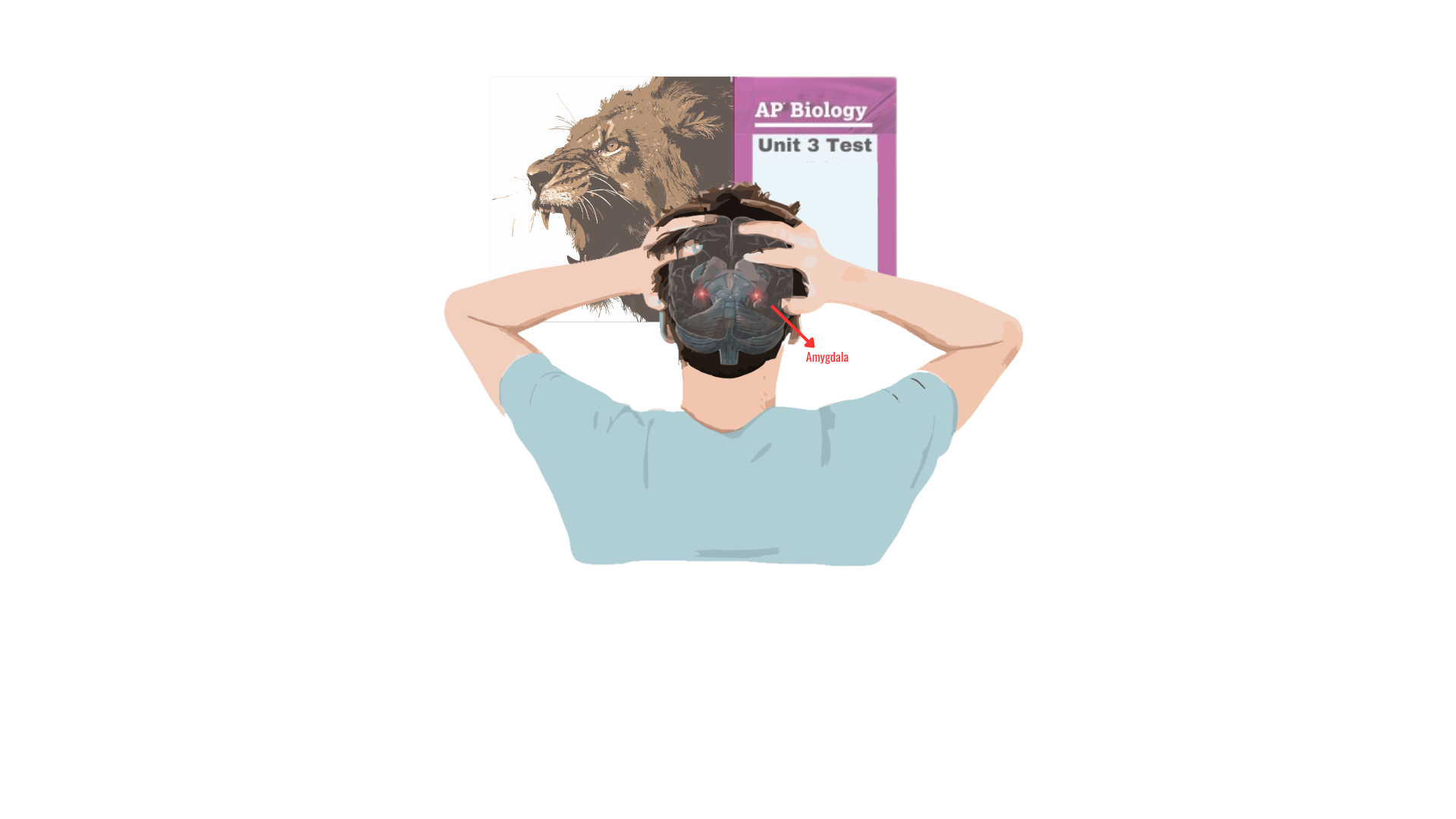
According to Harvard Health, the amygdala is an area in the brain that is responsible for emotional processing. When it perceives a threat, it sends a message to the hypothalamus. The hypothalamus then activates the sympathetic nervous system, which triggers the fight-or-flight reaction. Your body then releases stress hormones such as adrenaline and cortisol from the adrenal glands that are a part of the endocrine system.
The American Psychology Association explains how adrenaline quickens your heartbeat, sharpens your senses and floods your muscles with energy. Cortisol keeps you alert and ready to act. Together, they prepare your body to react, whether to being face-to-face with a lion or walking into AP Biology for your first test.
Not all stress is bad. In small doses, it can sharpen focus and boost performance.
“I think we see stress as an exclusively a negative thing,” Brown said. “Stress causes us to act. It causes me to get my grading done and you to get your studying done. It’s interworked with fear to keep us from not walking in the middle of Aloma during rush hour.”
Good stress, also known as eustress, gives you that energy before a presentation or boosted focus during a sports game. It is a way to keep you alert, motivated and challenged without feeling overwhelmed.
The problem is when stress starts to turn against you, going from helpful to harmful. Most know stress as feeling panicked, scattered or forgetful.
“You’re in the middle of something and you’re frazzled … then (you) say … ‘Oh God, I forgot A, B and C as well,’” Honors Anatomy teacher Brandon McDermed said.
Chronic stress can cause memory lapses, fatigue and muscle tension as cortisol overwhelms the brain’s learning centers. Long-term stress keeps cortisol levels high for long periods of time, affecting things like sleep to digestion to immune function and concentration. It is why students still feel drained after sleeping or eating well: The body is stuck in alert mode.
Physically, it can manifest in small yet telling ways. McDermed has noticed students picking their skin, whether it is their cuticles, face, eyebrows or lashes. If this stress goes on for too long, it can result in long-term health concerns like lack of appetite, which can cause issues like massive weight loss.
Though many factors lead to individuals’ varying response to stress, it is first and foremost determined by genetics.
“We underestimate the power genetics has on us,” Brown said. “Our genetic code dictates so much more than we’ve been giving it credit for. … You will more likely handle stress similar to how your parents handled it from a genetic perspective.”
Environment plays a role, too. How you were taught and how you have witnessed people close to you react to stress can influence whether you react to stress in a more intense or more laid-back way.
“They’re the people you interact with the most … so they’re the ones that teach you how to handle stress,” Brown said.
Your body is unconsciously mimicking who you are around, whether that is posture, tone or language, leading to a loop that makes us internalize and react to stress similarly to them.
“You’re going to become more like the people you surround yourself with, (and) they’ll become more like you,” Brown said. “Just like pack mentality, we’re built to want to be like those that we are around.”
In other words, stress is not only chemical; it is contagious. Stressors include anything that can cause emotional or physical tension. On our campus, teachers often see that in the form of cultural pressure to achieve good grades and prepare for the college admissions process.
That pressure often pushes students to focus on outcomes instead of curiosity. Many other institutions have stress but not much is done to turn it into something positive.
“I think we talk about (stress) a lot, but I think we talk about it in a very passive sense, not super fixated on ‘Let’s fix the problem,’” Brown said. “Students have so many tests right now, but then not much is done about it. So, although we do acknowledge it, I don’t think we’re doing a lot about it.”
The goal is not to erase stress, even with its negative connotation, but to understand it, turn a survival mechanism into a study partner. Stress does not necessarily mean that you are failing. It is better to differentiate between good stress and bad stress, in turn learning healthy coping mechanisms.
“Go live your life,” Brown said. “Be stressed out. Stress can be crippling, but it isn’t always bad. And if we’re always comfortable, we are often making it so that we can’t grow. But if we can access some discomfort, we can grow.”