


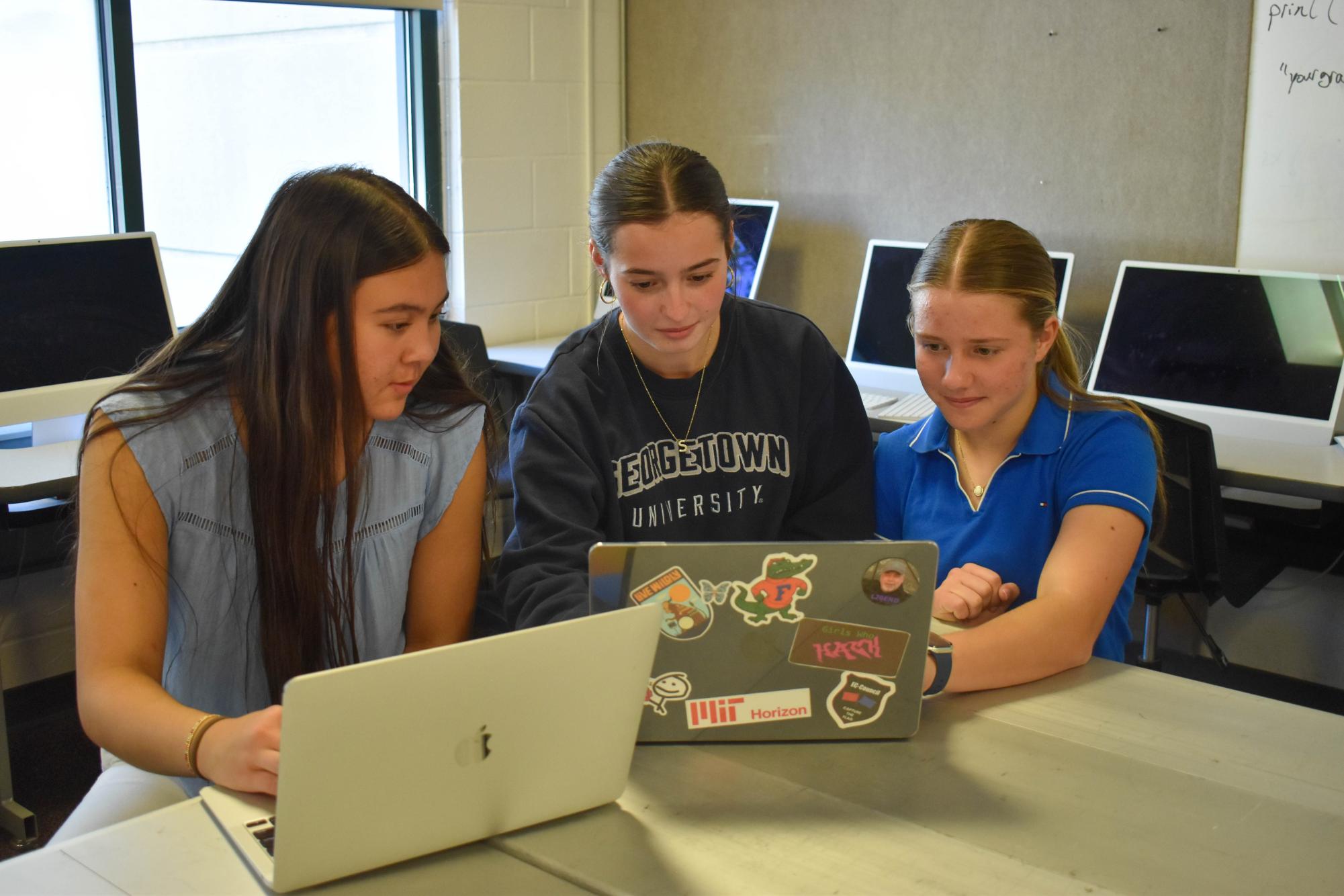
At the CyberPatriot competition this year, Trinity Prep’s all-girls cybersecurity team was tasked with handling three to four critical operations. These included checking for system updates, ensuring firewalls were active, configuring network links and setting up a new router. After a grueling four-hour session, where the team earned points for completing various tasks, they entered the nation’s top 30 in rankings. Their performance at CyberPatriot did not just showcase their technical skills, but it also significantly highlighted their role in confronting a much larger issue.
According to the Global Cybersecurity Forum, as of 2024, women made up only 24% of the cybersecurity workforce. These competitions often reflect this statistic, where most of the competing teams are overwhelmingly male. However, Trinity Prep’s all-girls cybersecurity team is challenging expectations and bypassing the firewall. Surrounded by male-dominated groups, they know what they are up against.
“We come knowing that we’re going to be seen as the underdogs because we are girls and we won’t be considered as smart or as talented as some of the guy-teams that we’re facing,” said senior Sarah Cantwell, captain of the all-girls cybersecurity team.
This feeling of underrepresentation is not new. Former computer science teacher and team mentor Susan Frederick faced similar challenges during her own college years.
“I remember when I was in college, I was the only female in coding classes,” Frederick said. “I was the only female in the engineering classes I took.”
Years later, these same challenges persist. Cantwell herself has personally encountered stereotypes that have often subtly downplayed her achievements.
“I got an internship with Lockheed Martin this summer,” Cantwell said. “It was said that I only got the internship because I’m a woman in STEM. It has been said that I’m a DEI hire or I was only there because they needed a girl face.”
However, Cantwell and the team have consistently broken down stereotypes through participating in the highest levels of national competitions. Their success is largely a result of the team’s continuous skill development and growth mindset.
“We are able to ask more questions within our group,” Cantwell said. “Documenting what we’re doing so that we can go back and look up better ways to do it after has helped us succeed in these competitions.”
Additionally, the team’s strategic use of task specialization has allowed them to achieve this level of success.
“We usually try to each specialize in something,” Class of 2024 alumna Lauren Neese said. “I specialized in Linux machines. We’d also have someone who specialized in Windows machines or somebody who specialized in networking.”
Consistent mentorship has also been essential to helping the team.
“I was making myself as available as possible in my room and in a location,” Frederick said. “We would meet at lunch and sometimes before school. I was also there after school if they needed me to be.”
However, Frederick could not always be there to assist the team, which made it important for them to learn how to succeed when working independently.
“I was mainly teaching them how to manage themselves,” Frederick said. “I would just get them started with what went right in the last competition, what went wrong, and then start them on their own research. The more I could hand it over to the students, the better I felt it was.”
By allowing students to take ownership of their progress, Frederick fostered a sense of drive that continued to motivate the team even beyond her guidance.
“I think you just have to have a passion for it and be willing to do the work to try and get better,” Cantwell said.
Alongside competing in CyberPatriot, the all-girls cybersecurity team has also participated in CyberFlorida, where the team placed in the top 25% of the state. These successes highlight the contributions that girls can bring to cybersecurity, challenging outdated assumptions about who can belong in the field.
“I hope people think that we’re not just diversity hires,” Cantwell said. “It’s actually something that these women can do and be great at and even compete against. I hope that it’s not like, ‘Oh, she’s a woman. That’s why she won.’ It should be, ‘Oh, she won because she’s awesome and she can do it.’”