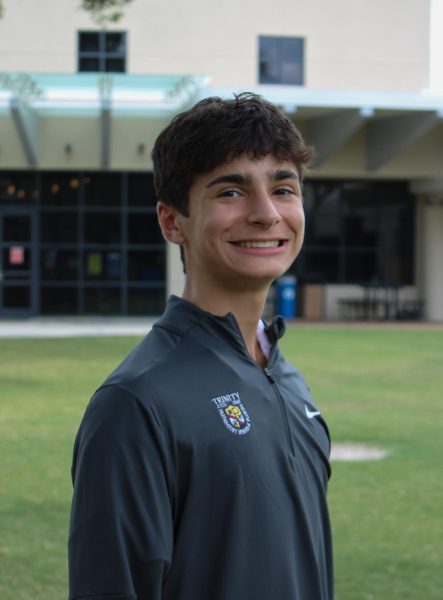

In an era where understanding financial literacy is more crucial than ever, the Trinity Prep Investment Fund, founded by seniors Nikhil Daniel and Owen Raffa, adopts a technical and pragmatic approach to teaching students valuable investing skills. The fund comprises 25 students across 10th through 12th grade, who invest in stocks through a pool of money raised through donations, fundraisers and student tuition funds.
“It’s important to emphasize that financial literacy in the tumultuous financial times we’re in is of critical importance,” said Assistant Head of Upper School Sebastiaan Blickman, who played a key role in getting the fund off the ground. “If our students can learn that through this real-life learning experience, then we’re all for the better for it.”
Before the fund became a reality, the fund’s leadership faced various hurdles that tested their resilience and adaptability.
“In our meetings with (Director of Alumni Relations Liz) McIntosh, the CFO (Michael Drake) and Mr. Blickman, there were a lot of times where Nikhil and I had to make compromises with them,” Raffa said. “For example, we originally wanted full freedom on everything we wanted to invest in, but we found out from them pretty quickly that was not going to be possible. … (So the) back-and-forth with admin to get all the details ironed out … (was) probably the hardest thing.”
The fund structure is divided between the executive board and four investment sectors. Each member of the four-person executive board oversees a specific area of the investment fund, ensuring all bases are covered.
Daniel serves as the fund manager and oversees everything about the fund while also planning fund meetings and guest lectures. The chief education officer, Raffa, speaks with local students and spreads financial literacy to the community. Senior Sarah Cantwell holds the position of chief technology officer, where she is responsible for creating and running the fund’s website. And Thomas Bonos, the chief investment officer, has the responsibility of overseeing pitch meetings and handling investment logistics.
The four investment sectors comprise Information Technology, Healthcare, Energy/Mining and Consumer, with each sector having three analysts and one associate who serves as the sector leader. Having four sectors diversifies the fund’s investments and provides a wider range of opportunities for students to specialize in and learn specific skills for a specific industry.
With the fund planning to start investing by the end of November, each of the four branches is currently preparing to pitch two stocks to other associates, the executive board and Trinity’s Board of Finance.
“As an analyst, I’m responsible for working on one-pagers,” said junior Campbell Alch, an analyst for the healthcare sector in the fund. “In my group, there are four or five people, and we chose two stocks, CVS and Pfizer. We are split and working on one-pagers to give the details of it, like the price, how it could (fluctuate, etc.).”
The fund’s structure parallels that of other college and high school investment funds, incorporating aspects from a diverse array of institutions, which enables it to prepare students for what to expect beyond high school.
“We already had connections with other high school and college investment funds … at (UC) Berkeley and UF,” Raffa said. “Because of those connections that we had, it was super easy to figure out things like fund structure, what your average meeting looks like, and that also allowed us to look more professional when pitching it to admin because we formatted our fund based on college funds.”
A key distinction between the fund and other student initiatives at Trinity is that it provides students with real money to invest. This, paired with the money’s ties to the school, creates realistic conditions for what it is like to be an investor.
“Nothing simulates real money more than real money,” Blickman said. “I can do a fake (simulator) online, but … when you add in that (the money is) tied to the school … you see a sense of responsibility … to make sure that I’m not just throwing letters against the board and hoping that I pick the right stock. So that’s a really cool opportunity to teach leadership, ownership, responsibility and the hard skills of finance.”
The fund highlights Trinity’s commitment to the learning process and to preparing its students for the real world, even if that means failing at first.
“(The fund) says that Trinity Prep is a place where we believe in the real-world preparation for students, where they can learn by doing rather than by lecture,” Blickman said. “It’s a place where even if you fail … there’s just as much learning to be had as to why that happened, what we missed, what we could have done differently, and that learning will stick with people just as much as the success will.”
This is accomplished by teaching navigational skills and creating an atmosphere that is not part of the standard classroom experience.
“The … analysts are not picked together with friend groups; they’re picked together by interests,” Blickman said. “It might not be your friends. It might not be people in your grade. It might not be people of the same gender. And so you need to navigate how to work in that team … and that’s a skill that you don’t get to practice as much in classes. … Whereas in this team, you’re all in very different places of understanding, different ages, different genders and different levels of comfort.”
The fund enhances this experience by inviting Trinity alumni and parents with diverse financial backgrounds to speak to fund members, offering unique insights into the world of finance and the work they do.
“(With the fund) bringing back speakers, it takes (learning) beyond theory and something you’d study in a classroom to the real world,” said Todd Hartung, assistant head of school for external affairs. “These are people who make their living doing this type of work, and they’re from all different fields. And so one, you get exposed to different positions or jobs that you may never have known existed, but then you’re also meeting contacts, our alumni and fellow parents.”
From this, the fund takes learning beyond solely technical understanding, focusing on the soft skills that are often overlooked in learning environments.
“My hope is that over time, you get comfortable having conversations with people you might see as investors or people that you want to learn from,” Blickman said. “When you see a speaker come in, you’re able to go and speak to them, ask them individual questions and carry yourself in a professional manner.”
But the benefits of having an investment fund extend far beyond simply advancing the knowledge, experience and professional skills of the analysts, associates and leaders who manage it. Over time, the fund also gives them the unique capacity to make a lasting and direct impact on students’ day-to-day lives across the entire school community.
“In five to 10 years, my hope is that this fund … (has) grown to a point where we can start to spin off 4% or 5% for student initiatives that better the student experience,” Blickman said. “At one of my previous schools … they were able to (use) that money they had earned through the investment fund’s performance and their analysis to buy new jerseys for all sports teams.”
However, there is a deeper lesson to be learned than just seeing the money from successful student investments being allocated to the student body; it teaches students that the learning and growth experienced at Trinity as a whole can make a real impact on another person’s life.
“That’s a tangible impact that this group of students’ learning had on the school,” Blickman said. “You learned how to invest in a sustainable, strategic manner that paid dividends over the course of five to 10 years. … Your learning had a direct impact on students.”
Beyond this, the fund symbolizes more than just an environment for learning and applying practical financial knowledge. It puts on full display the determination and intuitiveness of Trinity’s student body, which will hopefully spark new initiatives that may have seemed unlikely in the past.
“Even if an idea you have seems like a long shot, it seems like it would never get approved, it seems like it could never happen, if you sit down, work through it and work your hardest, it can and will be done,” Raffa said. “It was a super important realization that just because we’re kids doesn’t mean we can’t accomplish something great.”