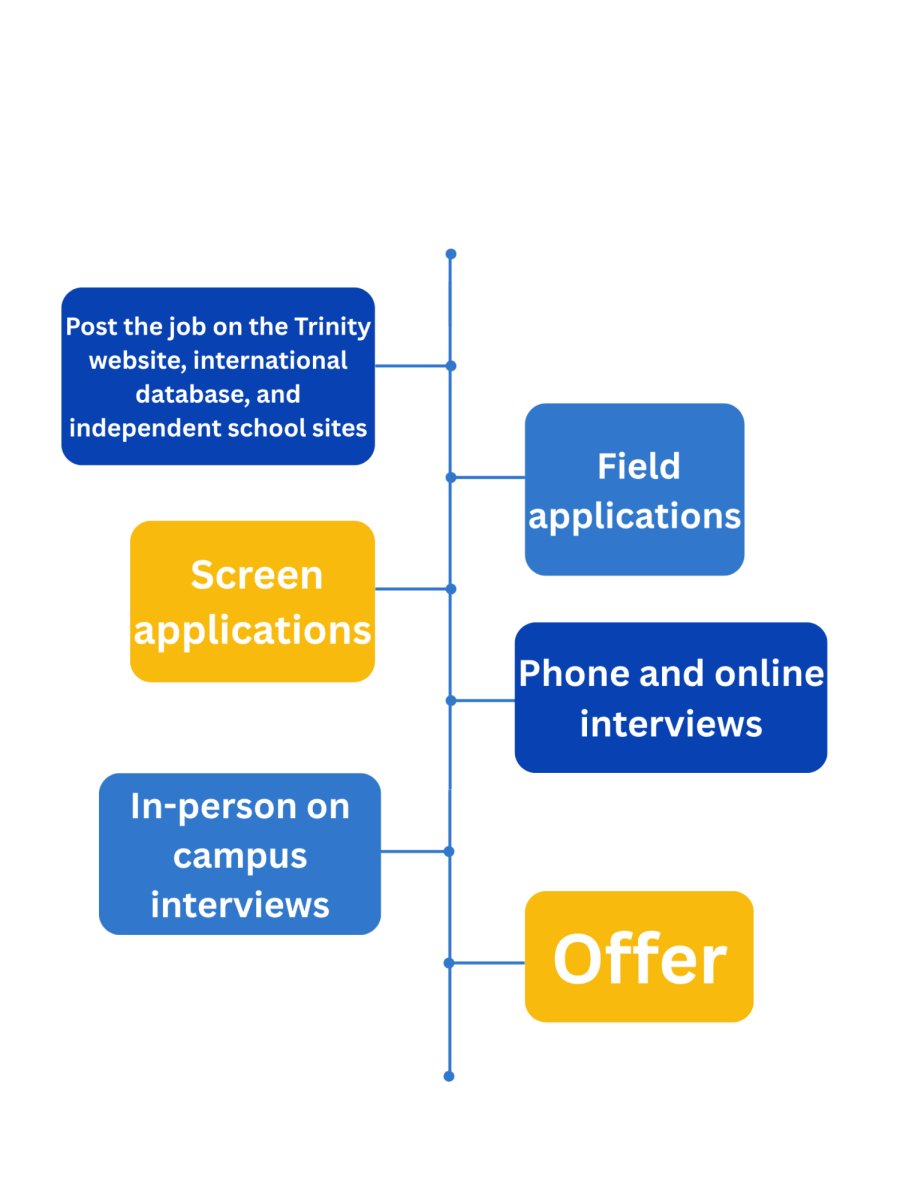
In recent years, Trinity has hired across nearly all departments and levels of leadership, making the hiring process an essential part of yearly operations. The systematic search and selection process comprises multiple layers from recruitment to on-campus interview rounds as the administration seeks to hire the best candidate from across the globe.
Since 2016, when he first came to Trinity, Head of School Byron Lawson has instituted changes that have fundamentally shifted some of the school’s hiring practices. Some major changes include expanding the process to be an international search for candidates, a written post-interview reflection rather than a conversation and a different approach to internal leadership promotions.
“There has been no change to the hiring philosophy, but the process has changed to be a little bit more formalized,” Associate Head of School and former mathematics teacher at Trinity Dennis Herron said. “We are trying to widen and deepen the depth and breadth of the candidate pool.”
Once a job description is finalized, the position is posted on Trinity’s website, independent school-specific sites like the Florida Council of Independent Schools, and an international database.
“The only way you can apply for a job is to go through our database, and that ends up getting shared with people all over the globe,” Lawson said.
Trinity is intentional about expanding the candidate pool and attracting diverse applicants to serve the school’s mission.
“The best way you can get a diversity of thought and perspective is to get different thoughts and perspectives into your faculty,” Lawson said.
Recruiting diverse talent is not just limited to geography.
“We want a candidate pool and a faculty that is reflective of our community,” Herron said. “When I say that, that is bringing a diverse candidate pool in, and we will pick the best candidate.”
The approach of selecting the best possible candidate also extends to internal promotions and job changes, where current Trinity faculty undergo the same process as any other applicant.
“I don’t think it is best for the school not to always look to hire and retain the best possible candidates,” Herron said. “When we have a leadership job, we have an obligation to test the market to see who can bring the most value to the school. Not that we don’t value our current faculty and staff.”
Herron, who went from a math teacher to associate head of school, said that his rise to leadership would be different now due to the current growth rate of the school and new hiring practices. Stephanie Dryden, former Trinity college counselor and director of learning and instruction (DLI), who now serves as head of middle school, proves that internal promotion is possible, receiving both her DLI and current position in the new system.
“In my history at Trinity, sometimes the process for internal candidates was a little bit different than external candidates,” Dryden said. “Now, I’ve just been part of the national search.”
The use of interim roles, such as the position Dryden held in the 2024-2025 school year as interim director of the middle school, can serve as a year-long, real-life interview for the role.
“(In an interim position), one of two things happens because you’re in a live interview,” Herron said. “Sometimes we will promote and offer them a full-time job, or we will continue to do interviews, and you’re still a candidate.”
Domestic finalist candidates are flown in for interviews with administrators and teachers and to teach a class to students. This is viewed by many, like Dryden and Science Department Chair Romina Jannotti, as the most important part of the holistic hiring process.
“In public school, I had a half-hour interview with an assistant principal, and at the end of that, I was hired,” Jannotti said. “So (Trinity’s hiring process) felt like I was being made to run the gauntlet.”
The interview process is the final step before offering a position and having the candidate accept the offer.
“The normal employment incentives are salaries, benefits, student ability levels, class sizes and the ability to teach a certain thing,” Herron said. “The best we can do (as a school) is to have as strong a salary and benefits package as any other school. We are very competitive in this area. Then, a lot of the time, it boils down to teacher preference.”
The end goal of this process is to attract and hire the best teachers in the world to join the Trinity family.
“In a world where people are saying Americans have declining education and standards, and we’re falling behind this country and this country and this country, I say, come on over, take a look,” Lawson said. “I don’t care where you’re coming from; that’s not happening here.”