Instead of working during class, 17-year-old senior Ethan Johnson, who asked to be identified under a pseudonym, spent the period betting on unfamiliar tennis players playing overseas in Europe and Asia — made possible by loose regulations and the wide range of betting options available on Kalshi.
“I have no knowledge about tennis,” Johnson said. “I bet on (them) because it was easy and quick.”
Primarily marketed towards teenagers, Kalshi is a prediction betting market — a platform where users can bet on whether or not real world events will happen in sectors like sports, politics or economics. Users can bet on results of a Manchester City match or the likelihood that bird flu will return. Unlike typical sports betting platforms where odds are set by professional analysts and bookies, Kalshi’s odds are entirely based on the demand for each outcome: if more people bet yes on a betting option, then the odds shift in favor of yes and vice versa.
Among high school students, prediction betting markets have become a loophole for betting on sports. Traditional sportsbooks require users to be 21 years old, while prediction betting markets allow participation at 18.
The lack of strict identity verification further lowers the barrier: underage users can get around the identification card check providing their parent’s driver’s license, allowing them to easily start placing bets. On traditional sportsbooks, users are required to submit a photo to confirm their face matches their ID — a safeguard absent on many prediction markets such as Kalshi. 16-year-old Sam Harris, who asked to be identified under a pseudonym, has taken advantage of these websites’ faulty security systems, allowing him to gain access despite being underage.
“If you want to get on, it’s honestly really easy,” Harris said. “Most kids use their parents’ ID. Nobody really checks, so once you’re in, you’re good.”
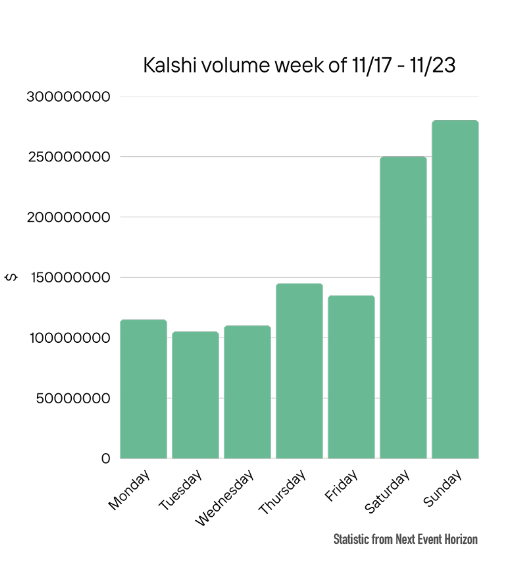
While users are able to place bets on a variety of sectors, statistics show that sports are the primary driver of user participation: Kalshi’s total trading volume hovers around $120-$150 million with spikes to $300 million on weekends, aligning with professional and collegiate gamedays.
Once inside the platform, users are met with an overwhelming number of betting options. Contracts and betting odds stack on top of each other, allowing users to scroll endlessly through available bets.
“Scrolling through Kalshi feels endless,” Harris said. “It’s like a casino designed to trap you in a loop and make you gamble.”
Users can watch prices fluctuate in real time and see how much money is flowing into each betting line. The interface resembles a live feed, where activity is constantly visible to users. Additionally, the site has a leaderboard that ranks the most successful betters. With activity always on display, participation feels communal, further luring teenagers onto the page by turning betting into a shared activity.
“When you see what everyone else is doing, it’s hard not to keep placing bets,” Harris said. “You don’t want to miss out on the fun.”
As bets accumulate, the financial consequences often follow. What begins as small experimental wagers can quickly escalate as users chase a big win. Losses can intensify gambling addiction.
When users lose bets, the website instantly offers another chance. Users are encouraged to re-enter into the market, with funds only a tap away. Over time, this pattern becomes routine. Losses cause reinvestment, and reinvestment keeps users engaged.
“Everybody has that moment when they’re betting saying: I lost (and) I want (my) money back,” senior and prediction market gambler Zevy Naft said. “They keep on doing it and doing it. I’ve definitely seen people addicted once (they) start to lose money. They go down (the) rabbithole.”
The platform appears to be more focused on expanding its user base than considering who is actually participating. Unethically, they are targeting and expanding to the most vulnerable demographic: high school students. Teens are especially vulnerable to online betting platforms due to their age, financial inexperience and constant exposure to gambling content. Kalshi’s marketing targets these vulnerabilities.
Kalshi’s growth has been fueled in large part by its presence on social media platforms, dominated by teenagers and young adults. Short-form videos on Instagram Reels and TikTok frame betting as an easy way to make serious money.
“Kalshi also markets to, and facilitates use of its platform by, users under the age of 18,” Massachusetts Attorney General Andrea Joy Campbell wrote in an official filing during the state’s lawsuit against Kalshi. “On the official Kalshi Sports Instagram account, Kalshi dedicates its posts to current sports events and sports-related pop culture, using memes and trending topics to entice consumers to enter into one of Kalshi’s sports event contracts.”
As a result, betting does not stop during class. For some students, gambling has become part of the school day itself, normalizing risk-taking during hours meant for learning.
“I probably spend about an hour or two of my day betting,” Johnson said. “There are definitely times when I’m in class and I’ll be working on making a bet.”
As prediction betting markets grow in popularity, particularly among younger users, some prediction marketing bettors at Trinity Prep have begun questioning whether current age limits are appropriate.
“I don’t want the age limit for prediction betting markets to go up because it’s fun, but honestly if I looked at it with a holistic view right now, it would probably be good if they raised the age level,” Naft said.
These markets can normalize gambling behaviors among teenagers, turning a simple guessing game into a gamble with real money on it without them fully understanding the risks involved.
“Gambling on (prediction betting markets) are more based on gambling to gamble,” Johnson said. “For instance, it might say, who’s going to win Time Person of the Year. You don’t really know anything about it. You just gamble to gamble.”
Teens should approach prediction betting platforms like Kalshi with awareness and caution. Underage high school students who sneak onto such applications should recognize the real risks, set strict limits and understand that what seems harmless can quickly become a harmful habit.