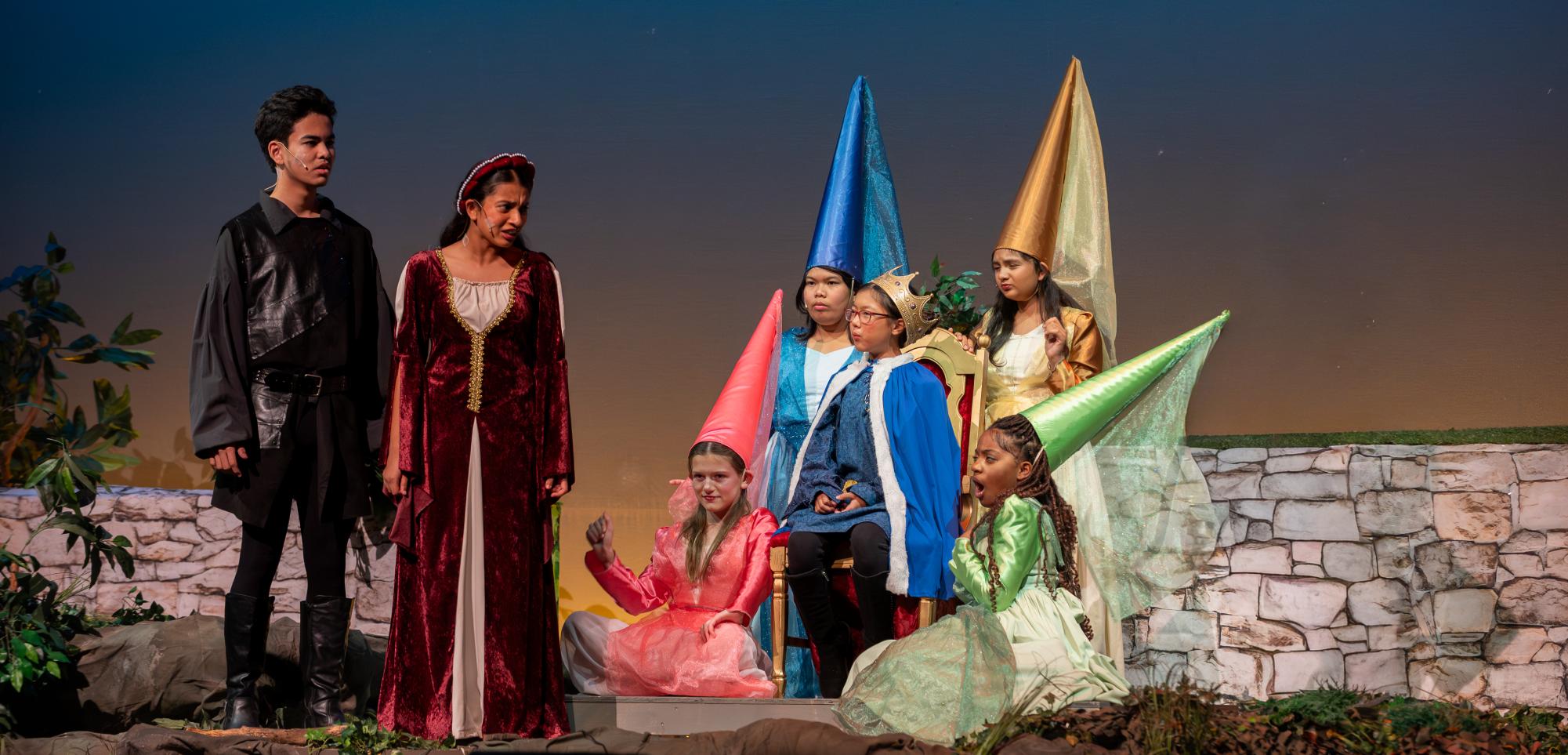
This year’s middle school production, “The Somewhat True Tale of Robin Hood”, ran from Nov. 12 to Nov. 15. The play takes a satirical twist on the classic tale of Robin Hood, full of comedy, laughter and witty situations. However, as much as it is written to make fun of the tale, the play does not stray far from its source material. Robin Hood is an outlaw who must save Maid Marian and return money to the townspeople from the exploitative prince.
The production was also be fine arts teacher Carlos Acevedo’s first time directing a play here at Trinity. As he is new, auditions were prepared by Jaine Papin, Trinity’s theatre director, and he came along to assist her through the process.
“I want to do things here that young audiences, students, can identify with, and can get joy from,” Acevedo said.
The tremendous turnout from middle school at auditions led them to decide on a double-casting arrangement. The cast included Ethan Blues (8th) as Robin Hood, Meha Shah (7th) and Leighton Mayo (7th) as Maid Marian, and Russell Kropp (8th) and Arianna Waltershied (6th) as the Town’s Guy. In particular, Mayo brought years of experience to this production, having been in theatre since she was four years old.
“ … I’ve done ‘Matilda’ twice,” Mayo said. “I’ve done ‘A Christmas Carol’, and I’m about to do it again. I’ve done ‘Cinderella’, and then this one.”
When rehearsals began, three times a week, Acevedo quickly noticed a discernible difference in student behavior from his last school, particularly in dedication and maturity.
“Even if I’m looking at a 12-year-old, they get theater in a way that makes me feel so happy and confident and excited and all of that,” Acevedo said. “Because in my old school, a 12-year-old was just running around being crazy.”
This did not mean, however, that discipline would be perfect in such an energetic environment as a rehearsal, particularly with such a large group of young kids. According to Acevedo, there have been a couple of instances when the rowdiness has gotten out of hand, and he has had to pause rehearsals. However, he noted that those instances have been few and far between.
“They don’t have perfect discipline,” Acevedo said. “They’re learning, but they’re … getting better (and are) very talented. And you know what? Talent holds everything together.”
In addition to the talent, he is impressed by how the students treat each other. The cast and crew held each other up with a high level of mutual respect and kindness, adding to the esteem they all share for the work they do.
“They are not looking into my part is larger than your part, or I’m the protagonist, or nothing like that,” Acevedo said. “They enjoy (equally) being the protagonist or being a very small part. … . And to me, they’re all the same too, so I treat them the same.”
The cast’s consideration of one another had allowed them to overcome various hurdles throughout the production. It supported them as they encountered individual challenges outside the rehearsal space.
“I want to start working on my lines a little earlier and my blocking,” Mayo said. “Now I’m kind of scrambling at the last second trying to memorize.”
Although it is not always easy, overcoming those challenges is part of what makes being part of such a production so fun. It is not supposed to be perfect or overly stressful, especially for school theater.
“I don’t want them to be so serious in there that they won’t enjoy the experience,” Acevedo said. “They went into that play because they wanted to have fun, and if I cut the fun out of it, then what’s the purpose?”
As rehearsals wrapped up and opening night approached, the cast was determined to conclude this experience as well as they could.
“I just want to have fun and put on a good show,” Mayo said. “Cause it’s really funny and I feel like we could have a lot of fun with it.”
As they reached the end, they could now begin to relax and enjoy the rest of the ride. After all, the primary goal for the cast of a play like this is to have fun and try something new. Acevedo ultimately hopes that the students formed an appreciation for the art that is theatre, and perhaps learned about themselves in the process.
“You are learning, most of all, to get to know yourself,” Acevedo said. “And that is very strange, because you’re playing another character, but you’re getting to know yourself, because you’re getting to know your capabilities and your feelings.”