When you’re applying to colleges, there are a lot of factors to take into consideration. As someone who just went through the college application process, I realized this pretty quickly. One really important aspect of figuring out where I wanted to go to college was the size of the school. I always knew I wanted a smaller school, which led me to discover the world of liberal arts colleges.
Some of you may never have even heard of liberal arts colleges like Pomona, Bowdoin or Swarthmore. Perhaps they are not on your radar because they only have a couple thousand undergraduate students at most, while the majority of state schools like Florida State University can have over 30,000 undergrads. In that way, liberal arts colleges are the exact opposite of your typical large state school.
A liberal arts education is all about branching out, exploring and taking classes across different subjects. You are encouraged to take classes in whatever your heart desires, not just classes in your major. You’ll get a broader education compared to a more narrowly focused or pre-professional education elsewhere. In fact, some liberal arts colleges like Amherst, Grinnell and Hamilton don’t even have core requirements for which classes to take.
But what’s so good about these small colleges? Below are three reasons why you should consider applying to liberal arts colleges.
Valuable Education in AI Age
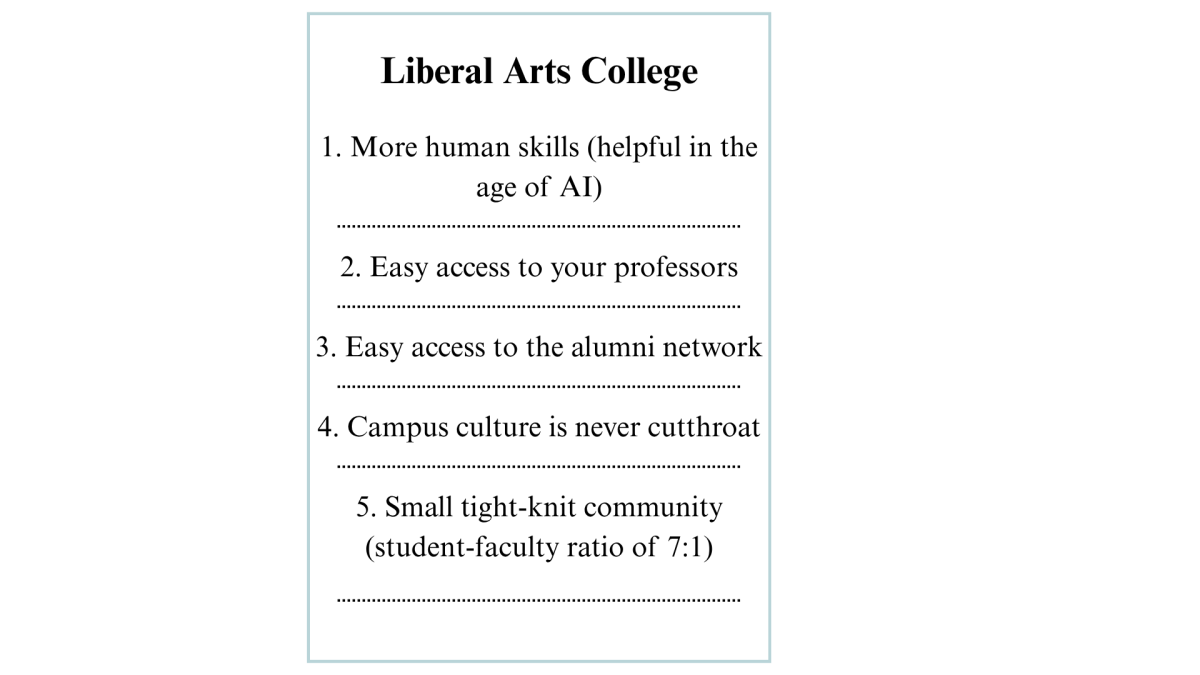
Nearly all liberal arts students take classes in both STEM and the humanities. It’s a common misconception that not picking a high-paying STEM major like engineering or pre-med makes it hard to get a high-paying job. (Not true!) It’s also a misconception that if you major in something like history or philosophy, your only career path is academia. (Also not true!) Nowadays, employers are actually looking for students with a liberal arts education more and more in the age of AI. Interestingly, former Starbucks CEO Howard Schultz majored in communications, and former YouTube CEO Susan Wojcicki majored in history and literature. While you should obviously major in what interests you, it can be helpful to take classes across different disciplines.
According to a January 2026 article in Forbes, in the age of AI, which can replace many jobs, employers are placing more value on a liberal arts education because it develops both critical thinking and the ability to see connections across disparate fields. You also get a better understanding of human nature, culture and ethics.
More Access to Resources
At most state schools, you will find yourself surrounded by 30,000+ undergrads, and that’s not even counting the grad students. For example, the University of Florida reported that they had 39,794 undergraduates in Fall 2024. They also have a student-faculty ratio of 17:1. Meanwhile, your typical liberal arts college like Williams College has only 2101 undergrads and a 7:1 student-faculty ratio, according to Williams’ website.
Another advantage of small liberal arts colleges is that you will have much more access to resources such as research funding, professors and an easily accessible alumni network. Professors are focused on undergrads, not the grad students. Fewer undergrads also means that clubs are easier to join. Usually competitive clubs like the consulting or finance clubs are a lot easier to join at smaller liberal arts colleges and won’t require interviews to join. Sometimes, bigger schools where you have to compete for the same resources can be cutthroat, but not at liberal arts colleges.
Small Community
Finally, liberal arts colleges have a small, tight-knit community, almost like Trinity’s. Most students live on campus for all four years. Also, smaller classes mean that having really thoughtful conversations among your classmates and your professor is easy. The small class sizes also make it easy to get to know your professor (who will never be a teaching assistant/grad student). Because they are able to form these relationships, students even have opportunities to become research assistants to their professors as undergrads.
Liberal arts colleges may have their downsides, like usually not having strong sports programs or huge party scenes, but this is made up for by all the benefits that they have to offer.