In the United States, students are told to “do it all”: excel academically, lead clubs, play sports and build a well-rounded identity. But this balance is inherently unstable. Something has to give, and too often, it is academic rigor.
In many Asian countries, education is treated differently: as a serious, disciplined pursuit that demands consistent effort and sacrifice. It is the primary responsibility that the child has, not one priority among many. The U.S. should not fully replicate these systems, but it should adopt their emphasis on discipline and academic focus, especially in the way it defines success, because right now, it is not demanding enough from its students.
A major reason for this imbalance lies in the structure of the college admissions process. Unlike systems in other countries that rely heavily on standardized exams, U.S. colleges evaluate students holistically. GPA, extracurriculars, leadership roles, essays and recommendations all factor into admissions decisions.
This approach creates individuality, but it also spreads students thin. Instead of mastering academic material, students often prioritize building a long resume. The result is a system where effort is divided rather than concentrated.
Standardized testing in the U.S., particularly the SAT and ACT, was originally intended to introduce a more objective measure of academic ability. In theory, these exams could serve as a step toward the solely merit-based evaluation seen in countries like China and Singapore.
But in practice, their influence has weakened.
According to a 2025 Crimson Education article, more than 2,000 colleges have adopted test-optional policies in recent years, largely in response to the COVID-19 pandemic. While some institutions — including all eight Ivy League schools — have begun reinstating SAT and ACT requirements, overall the tests do not carry the same weight.
The system has lost one of its few shared measures of academic performance, reinforcing an environment where expectations vary and rigor is inconsistent.
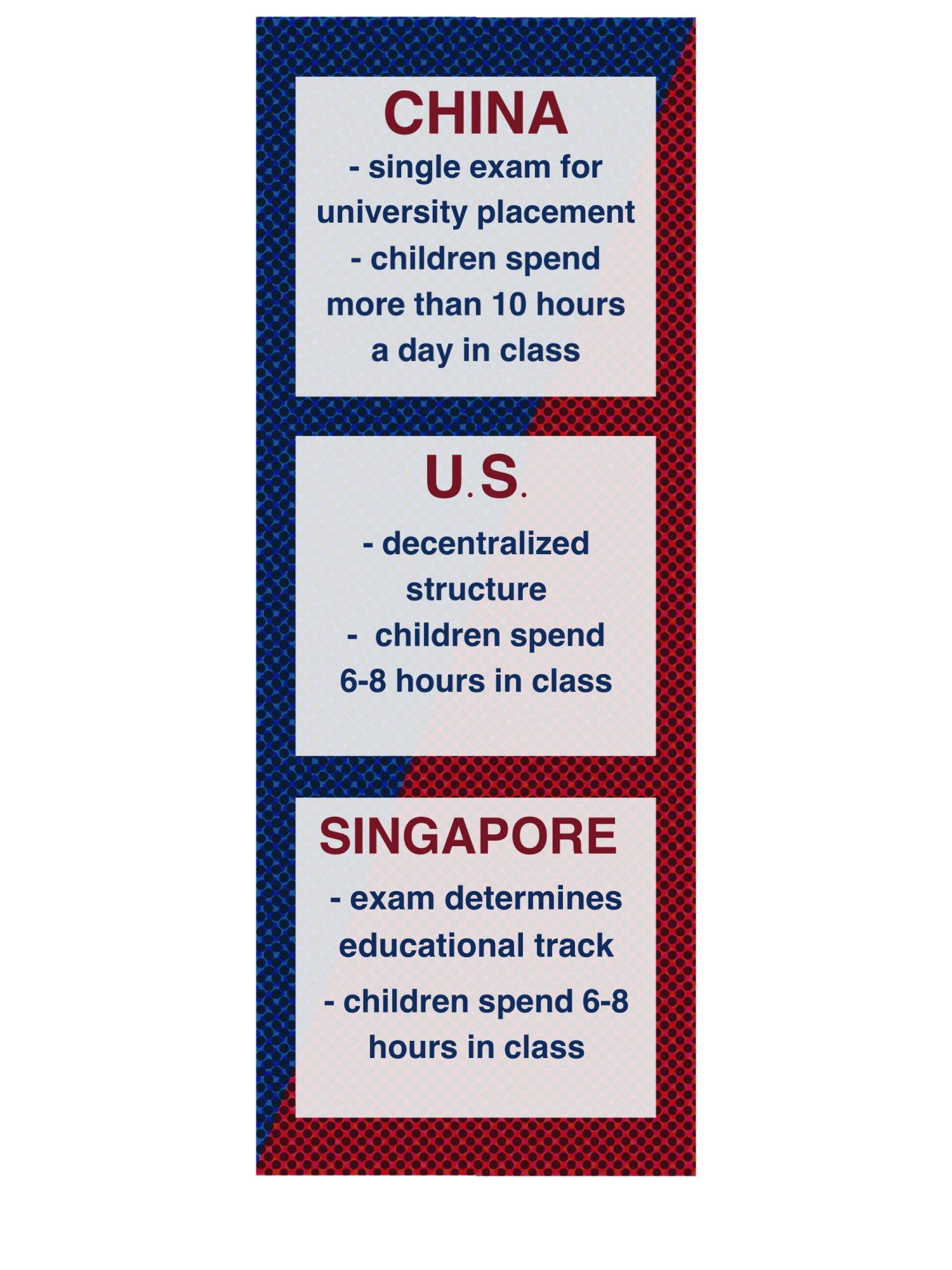
China’s education system reflects the kind of sustained academic intensity the U.S. often avoids. With the largest state-run education system in the world, students there follow a highly structured curriculum centered around the Gaokao, a single exam that determines university placement and, for many, future opportunities. Students attend long school days, complete hours of homework and often participate in additional tutoring.
“It’s the college entrance exam,” said senior Wilbur Liang, who was educated in China up to middle school. “They don’t care about GPA. … One score determines your life.”
Singapore follows a similar model. It is a meritocratic system that relies heavily on standardized exams that determine what schools students attend and what opportunities are available to them.
“You would take this big public exam, and your results determine basically the next school you go to,” said sophomore Akkaash Naidu, who had previous international schooling in Singapore.
These systems are undeniably effective. They produce students who are disciplined, academically strong and accustomed to hard work.
“Having elementary and middle school in China … is the best because (in America) you won’t train yourself that self-discipline when you were a kid, like learning how to concentrate on one thing,” Liang said.
Without a set academic benchmark, expectations within America vary widely between schools, making it difficult to define what academic excellence actually means. Excessive flexibility in what students can focus on makes it easier to avoid academic challenges.
“What I would say is, in China, we learn relatively more narrowly, but more deeply, but here we learn a lot of (variety) … but not that deep,” Liang said.
The tradeoff is significant. While American students gain breadth, they often lose depth — and with it, the kind of academic endurance that builds long-term success.
The difference extends deep into culture. In many Asian households, education is seen as the primary path to stability, and both parents and teachers reinforce that belief.
“I would say (the teachers in China are) much more supportive than teachers here,” Liang said. “One of them spent two hours after school with me for nothing. … They don’t receive extra salaries or anything. … They’re just trying to be the best teacher they can to (their) students. I would say … they sacrifice their whole life as a teacher.”
That support exists within a system where pressure is built into the structure itself. Students are constantly aware of where they stand, encouraging them not to disengage since the consequences are immediate.
“Every single month … we will actually (see the) ranking (of) who scores the highest to the lowest,” Liang said. “It’s published (for) everyone.”
In these environments, comparison is constant. The pressure drives students to perform but comes with a steep cost.
“A lot of students may … emotionally suffer,” Liang said. “Not in Beijing too much because (it is) the capital, but in some smaller rural areas, like all they care every single day (and) study, like 24/7, and they will have some issues, mental issues.”
The mental health consequences are real and cannot be ignored. This is where the American system succeeds. Students are encouraged to explore interests outside the classroom, develop socially and prioritize mental health alongside academics.
But that does not mean there are no ways the U.S. should take education more seriously. Students benefit from structure, discipline and being pushed beyond what feels comfortable. With stronger support systems and a greater emphasis on mental health, the U.S. is better equipped to handle that pressure without letting it become overwhelming.
“I would say students that go through the Chinese education system will be more resilient,” Liang said. “They suffered a lot when they were a child. So in the future when they have a lot of troubles and they are having problems, I would say they would be more resilient.”
That does not require a system built on a singular high-stakes exam, but it does require clear, nation-wide academic expectations. Schools can raise the standards by emphasizing mastery over participation and creating consistent benchmarks across classrooms. Standardized testing — used carefully — should return as a consistent part of the admissions process. Requiring test scores, while weighing them alongside GPA and coursework, would help restore clearer guidelines.
America should not become Asia, but it should become more serious about education — and then use its resources to do it better. Success should not come at the cost of well-being; it should be built alongside it.