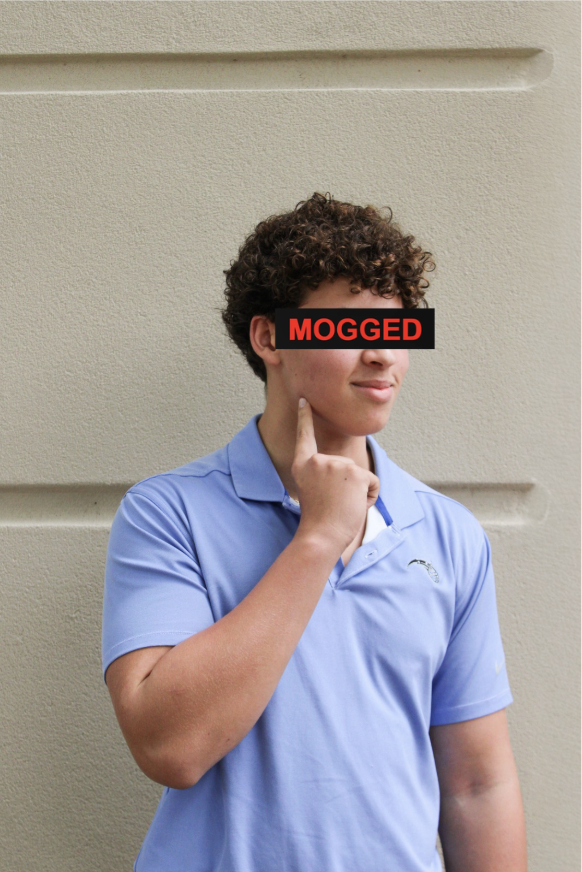
In the past month at Trinity, Upper School students have developed a number of new daily habits: bone smashing, analyzing the geometry of their skulls, rating fellow students based on the looksmaxxing scale and watching Clavicular streams and the television show Smallville.
This trend, known online as “looksmaxxing” and “blackpill,” focuses on optimizing physical appearance through the analysis of facial structure, lifestyle changes and a surprisingly complex vocabulary.
Central to the movement is the PSL rating scale, which students claim allows for the precise classification of human attractiveness. According to the scale, individuals are sorted into six categories: LTN (low-tier normie), MTN (mid-tier normie), HTN (high-tier normie), Chadlite, Chad and the rarest category of all, true Adam.
Students say the system depends on careful measurements of bone structure, facial symmetry, eye spacing, jaw projection and a term known as “facial harmony.”
This trend’s rapid growth in Trinity has been linked to a recently introduced elective, informally referred to by students as “Looksmaxxing 101.” This course focuses on appearance optimization and covers topics such as Bone Structure Theory, cranial angle analysis and the mathematics of ideal eye spacing, among others.
The community has also developed its own internal debates. One of the most heated topics currently revolves around whether internet personality “Clavicular” looks better than Brazilian supermodel “Chico.” Sophomore Max Menard said the discussion is still ongoing.
“There’s a serious argument about whether Clavicular mogs prime Chico,” Menard said. “Some people think that Clavicular’s low body fat and jawline can outshine Chico’s facial harmony. Personally, prime Chico mogs Clavicular every day of the week. He was the OG with the most appeal.”
Meanwhile, certain terms have entered the everyday student vocabulary. Words like “incel,” “normie” and “molecule” now appear frequently in conversations about looksmaxxing. Faculty members struggle to stay up to date with these new vocabulary words, explaining how they are still adjusting.
“Last week, a student tried to explain the difference between a ‘Chadlite’ and a ‘true Adam’ to me,” Assistant Head of Upper School Sebastiaan Blickman said. “I think I ended up more confused than when I started.”
The movement has also unexpectedly begun a shift in entertainment choices. In recent weeks, many students have reportedly begun watching the early-2000s television show “Smallville,” using actor Tom Welling as a reference point for aesthetics.
According to data from the Totally Official Trinity Institute for Looksmaxxing Research (TOTILR), “Smallville” viewership has increased by over 41% in the past two weeks, largely due to what researchers are calling “mogging references.”
However, with the introduction of an intense focus on physical appearance, a counter-trend has also begun. Known as “personality-maxxing,” this new movement encourages students to improve social skills rather than analyzing their facial geometry. Suggested exercises by the Personality Movement Institute (PMI) include maintaining eye contact, holding conversations without checking a mirror and speaking to another human being without the assistance of a ring-light. Administrators say they are still observing the trend as it develops.
“Every few years, students invent a new language that adults struggle to understand,” Blickman said. “Last time, it included ‘Skibidi Toilet’ and ‘Sigma Wolf.’ But this may be the first time it’s involved complex diagrams of skulls and bone structures.”
For now, the looksmaxxing community continues to grow. While the long-term effects remain unclear, Blickman says he has learned at least one lesson.
“Honestly, if students are determined to maximize something, I’d just recommend sleep,” Blickman said. “I’m a true Adam anyway.”

![[SATIRE] High-Cort Classes Terrorize TPS Intellectuals](https://thetrinityvoice.com/wp-content/uploads/2026/04/sami-blickman-900x1200.png)