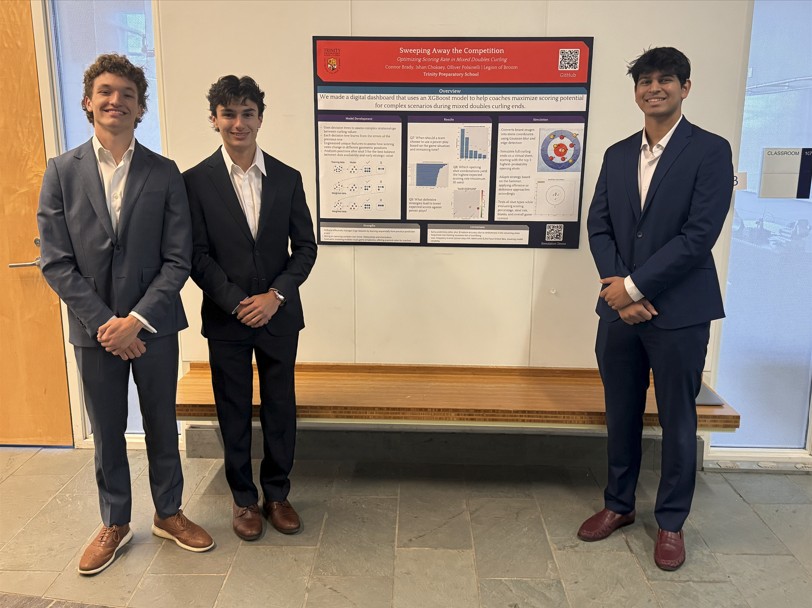
Carnegie Mellon, Yale and Harvard are just some of the teams seniors Ishan Choksey, Connor Brady and Olliver Polsinelli beat in this year’s Connecticut Sports Analytics Data Challenge. Selected as one of four finalist teams in the undergraduate/high school division, the trio advanced to present their research at the Connecticut Sports Analytics Symposium from April 10 to 11.
The competition centered on mixed doubles curling, an Olympic sport in which teams slide stones toward a target on ice. It required students to work with large datasets and develop their own research questions. Choksey, Brady and Polsinelli chose to focus specifically on the “power play,” a once-per-game option that shifts pre-placed stones to the side. Their analysis examined how this strategic decision impacted scoring outcomes.
“They had data from a bunch of different Olympic events over various years and they just had to figure it out,” team mentor and Mathematics Department Chair Donald Worcester said. “The actual competition gives some possible questions to look at. They don’t have to use them, nor do they have to use all of them. … It is 100% (really) student-driven.”
For the team, that independence meant learning the sport from the ground up. With little prior knowledge of curling, they had to quickly understand the rules and strategy before they could begin their analysis.
“We didn’t really know anything about curling,” Polsinelli said. “We had to learn the entire sport from scratch and learn a lot of the strategy behind the sport itself as well as what everything meant.”
This learning process extended into how they handled the scale of the project, where they had to break down large amounts of data and reorganize them into a structured format that could actually be analyzed.
“There were 25,000 different curling shots that we had to be able to analyze and actually make matter,” Polsinelli said. “We created unique IDs for each of the shots to connect it to each of the games so we could assemble all the data into one large spreadsheet, which helped make it a lot easier to analyze and actually make usable.”
Despite the complexity of the project, the team worked collaboratively to manage different parts as it developed.
“Connor was our main coder,” Polsinelli said. “He built the majority of the model. Ishan and I primarily wrote the paper and just put everything together that Connor made.”
Alongside a detailed paper and model, the team produced an interactive tool built to translate their findings into real-time strategy.
“We created an interactive dashboard that a prospective curling coach could use,” Polsinelli said. “The simulation would put forward, based on our model, strategic advice as well as show the team use of a power play on a scale from one to 10. (It would also) show a simulation of all the highest likelihood shots for scoring and would model it out through all 10 shots. You could see what the final score would be if you continued with the best strategy available (in the game).”
This simulation is what the team believes truly distinguished their project from others in the competition.
“Adding that application was a massive improvement, and it’s what all of us believe managed to get us to Connecticut in the first place,” Polsinelli said. “It’s nothing that any of the other teams that we saw there did. And I think it’s really what stood us apart.”
Though they competed against students at a much higher academic level, the team ultimately still earned its spot as finalists in the challenge.
“They’re competing against the top data science and sports analytics (colleges),” Worcester said. “Multiple college professors read these. So I’m pretty proud of these guys.”
The group’s success was driven by their dedication and commitment to put in the extra work.
“A lot of it is just how much work they want to put in,” Worcester said. “A lot of it is self-taught, (and) they took the time to learn extra. It’s simply their drive and their wish to do well. I feel like the best computer programmers, you can teach them, but you really need that self-motivated individual to learn it.”