Surrounded by woods and water, Trinity Prep has an abundance of bird species that call our campus home. From killdeer to muscovy ducks, each of these creatures plays a unique part in the campus ecosystems, and for anyone in the community who takes the time to observe them, the birds on campus can be a hidden treasure.
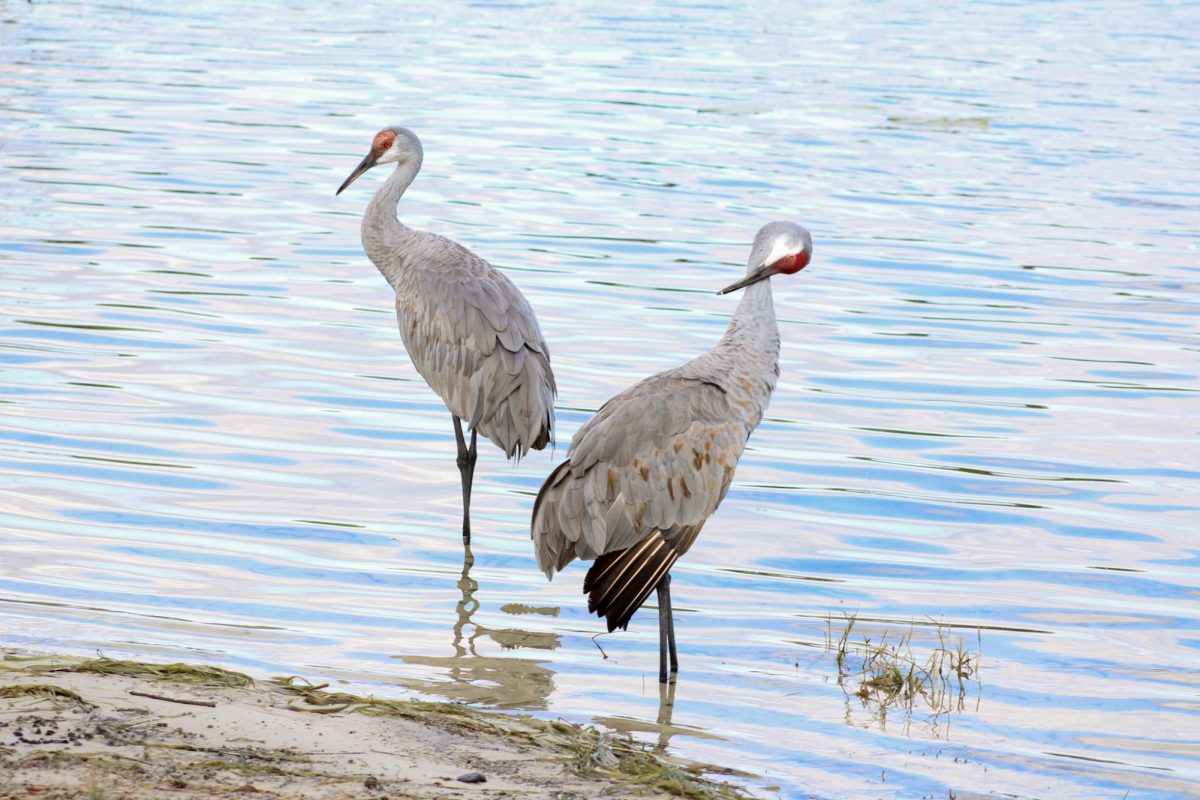
With its elegant, long legs, the sandhill crane is one of the most visible bird species on campus. Every spring, a family of sandhill cranes nests around campus, and in most years, it will have at least one baby colt.
Being raised in a school, the family finds open fields and wetlands around classrooms to maintain their diet of plants and insects.
“I pay attention to them and I get very excited whenever they have their new baby,” English teacher Steve Krueger said.
Another common bird species found on campus is the killdeer, with tan upperparts and white underparts. Additionally, these birds have two prominent black bands around their neck, almost like a double necklace.
In the early spring, they can be found nesting around the track, which can pose a problem for the physical education classes.
“We were walking around the track, and some sixth graders came over and were stomping around the birds’ nest,” freshman Melinda Kahn said.
However, because these birds are protected under the Migratory Bird Treaty Act of 1918, it is illegal to disturb their nests, with penalties including fines and even jail time.
Despite the disruptions, the killdeer still nest around the track to have the best survival rate for their young.
“We walked on the opposite side of the track, not near the fence where the birds were, so we would avoid them,” Khan said.
Although the national bird is the bald eagle, it is not the most effective avian hunter on campus. With dark back plumage contrasting a white belly, ospreys can often be seen carrying fish back to their nests above the lights of the football field, tempting eagles to try to steal a free meal.
“Eagles are bigger, though, so they’ll let the other birds do the hard work and then they’ll steal from them,” Krueger said.
However, ospreys have learned to adjust to these thieves by sharing nests and using each other to gang up on the eagles, allowing ospreys to thrive.
Everyone who has been on campus knows the crows. Staying in Florida year-round, there’s no getting rid of them. However, this isn’t always a bad thing. According to the Humane World for Animals, in a single nesting season, a family of crows can eat around 40,000 insects and other grubs.
On our campus, though, the crows have another food provider: the students.
“One time, I put seaweed in my side pocket in my lunch box and then when I went to get it, it was gone,” Kahn said.
Although not always an invited guest to campus activities, these birds have still become a part of the Trinity family.
One species Trinity could use less of is the muscovy duck.
Unlike some of the other birds on campus, the muscovy duck does more harm than good. Brought to Florida from their native habitat in Texas, these invasive ducks can carry diseases to the native species in the area.
“These are bullies, but in a bad way,” Krueger said. “They push out native duck populations.”
In addition to its infectious impact, the muscovy duck is also aggressive toward other animals, including humans. Due to its invasive status in the state of Florida, it is legal to kill these ducks humanely, even without a hunting license.
Whether it’s native or invasive, all birds on campus can add a touch of nature to the busy lives of the campus community.
“There’s a little bit of a disconnect between… some people and the natural world,” Krueger said. “And I think there’s value in realizing that there’s other things going around us that we take for granted.”