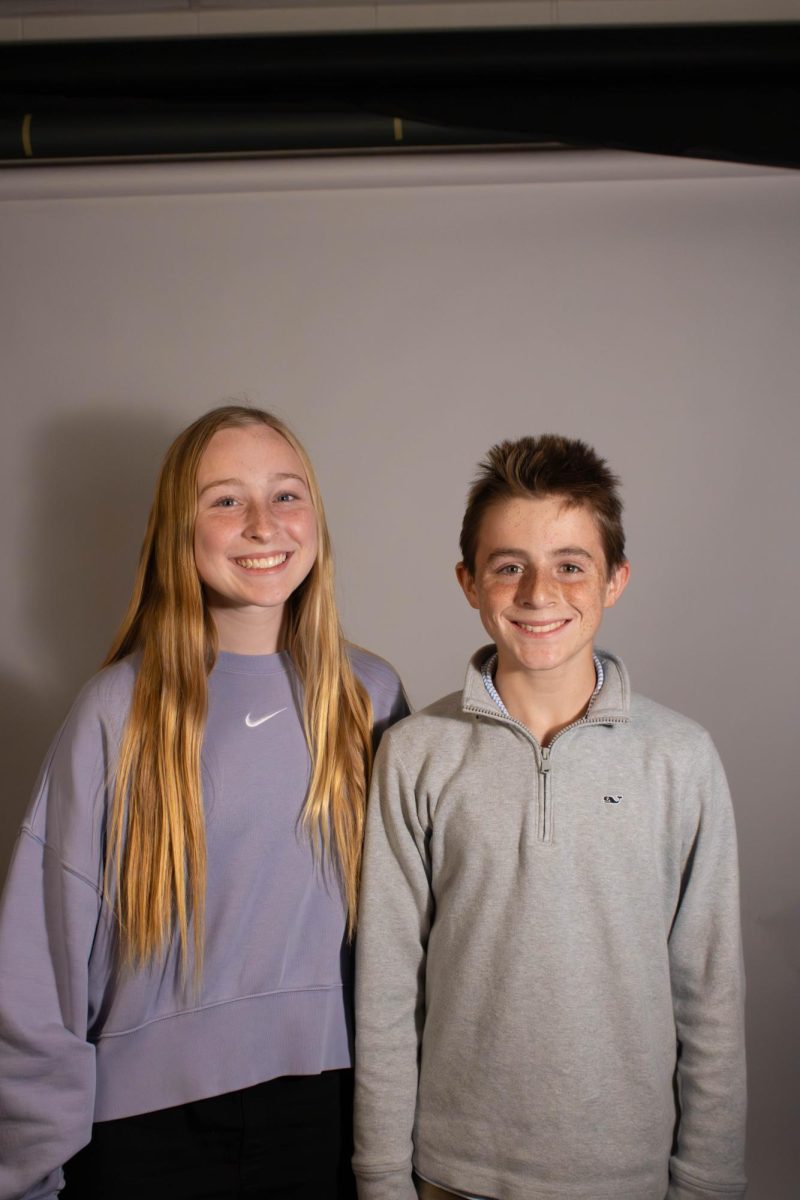
Freshman Grant McElveen clicks send, delivering a video of his Jack Russell terrier doing cartwheels to his friends. The lifelike video wowed them all, but it was really nothing more than the result of a quick digital prompt.
Artificial intelligence is most often pinned as students’ number one homework helper. However, as the technology has advanced, so has its usage for various tasks. Now, many like McElveen are creating fake photos and videos that are indistinguishable from reality.
AI-generated photos and videos have become especially popular in younger generations, often used for harmless pranks or tricks.
“I use AI (generated) photos and videos to trick my friends all the time,” McElveen said. “They think it’s so funny.”
All generative AI technology is built upon roughly the same predictive model, using information from trends, people and places.
“Every AI large-language model, including the image and video generation ones, and the music ones … operate(s) on a predictive text model,” said alumnus Karthik Stead, who is studying media at New York University. “They all look the same because they’re all trained on the same things.”
The lack of human creation is what the AI media world is missing. AI media does not come from genuine creativity but rather from the monotonous results that an algorithm produces.
“The best kind of art, that kind of thing comes from very real experiences and people pulling from real stuff that’s happened to them,” Stead said. “You lose that when you have a robot just making, really, what would be the most likely outcome.”
The generation of photos through AI can become dangerous quickly, the most harmful kind being called “deepfakes.” According to Statista, as of 2024, 29% of fraud experts have come across AI-generated video deepfakes as a way to trick people into scams.
“AI is already used, in terms of online, but when it’s used even on social media, and people start falling for it, that’s how rumors start, and these rumors can be really harmful,” freshman Damien Layus said.
The dangers of AI arise when real content becomes indistinguishable from AI. While some photos have small disclaimers stating, “contains AI-generated material,” many do not, causing confusion.
“There has to be some kind of sourcing behind that: ‘This is AI-generated,’” social science teacher Rick Rodrigez said. “(That) lends itself well to our discipline in the social sciences so that we can look at multiple sources, information, and try to figure out what is true and what is not true.”
When it comes to education through visual representation, AI can be beneficial. Pulling from multiple different resources, AI re-creations can allow students to have a visual match with the information given. Rodriguez incorporates AI media into his lessons by re-creating historical resources and asking students to analyze how they differ.
“If AI is going to be a thing outside the classroom, then we also need to prepare our students to deal with the reality that AI is here to stay, so for me, (I think) we should embrace AI,” Rodriguez said. “For me, (the comparison of AI and primary sources) creates a little bit of critical thinking because we’ve delivered the content and then you compare and contrast (the two).”
With the right resources and environments, AI media can be safely used as a tool. However, if left unchecked, the growth and improvement of AI media can cause harm when it comes to misinterpretation and obscuring the truth.
“You’re looking at situations where it can hurt people, because people are using those deliberately AI-created visuals, videos (and) pictures, and they’re using it to bully people or to make someone feel lesser than they are,” Rodriguez said. “I would hope eventually some laws are passed that puts an end to that kind of (misuse).”