A student’s first car means freedom: no more waiting for rides, arriving based on your own schedule and music blasting with the windows down. But behind that freedom lies cost spreadsheets, insurance bills and quiet negotiations at the dinner table.
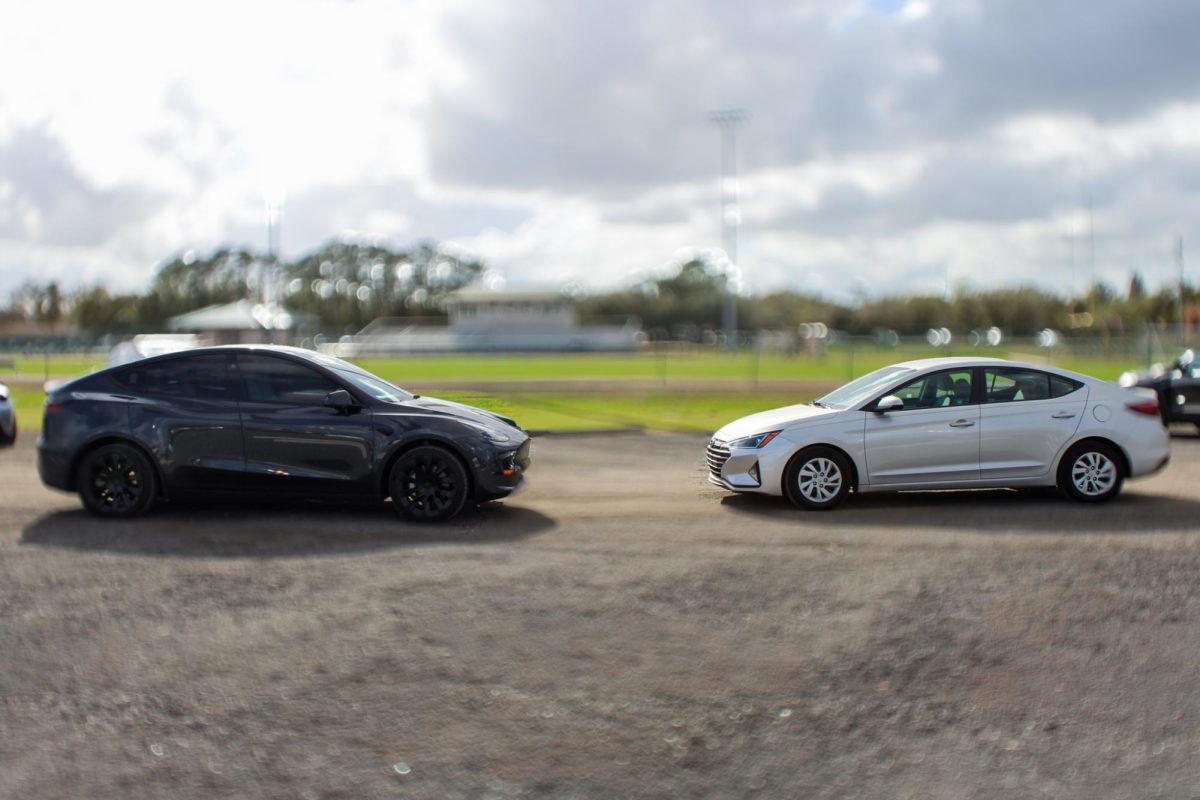
For sophomore Srian Kondapalli, who drives a 2024 Tesla Model Y, the conversation of what car he would drive started before he had his license. His parents had already begun thinking about the logistics, such as helping transport his sister to school, which set the stage for the eventual decision. As the possibility of getting a car became a reality, the focus shifted from excitement to utility.
“My top three priorities are cost, comfort and speed,” Kondapalli said. “My main priority is just not to put too much stress on finances.”
While he valued performance and comfort, safety was not initially a concern.
“At the forefront, I didn’t really look at (safety) as a big deal because all cars have safety features,” Kondapalli said.
His parents, however, viewed safety as a central factor from the very beginning.
“The safety and being able to control how fast he can go or to track him, is more important than having the most expensive car,” mother Anupama Kondapalli said.
Though Srian Kondapalli had considered other options, including sportier models and more prestigious brands, affordability, practicality and his parents’ preferences influenced his final decision.
“My dad did give me the option of getting a BMW, but I decided to stick with the Tesla because we already had the car, so that made it affordable,” Srian Kondapalli said. “Since it’s electric, it’s also cheaper in that sense because we already have a charging station. Also, the Tesla is really smooth to drive and has some of the best safety features.”
The operating costs of electric cars were also a deciding factor.
“With electric cars, it’s easier because they are maybe a little bit more expensive when you buy them, but to run them, it’s much cheaper,” Freedom Driving School Instructor Steve Farkas said. “No oil changes, no air filters (and) no head gasket (means) nothing is going to go wrong with an electric car.”
Beyond cost, modern driver-assistance features helped shape the family’s decision to give Srian Kondapalli a Tesla Model Y.
“All of these newer cars are going to give you a lot of alerts about following distance, lane keeping, and a lot of things,” Farkas said. “It just makes driving easier. Many cars have self-driving features, which makes it even safer. … Many times, students realize they are too close to cars when they get the forward collision alert or the lane departure warning.”
Altogether, Farkas says electric cars are generally safer, citing Tesla as a prime example. Their large battery pack, mounted low under the floor, is heavily reinforced to reduce the risk of fires and save the passengers.
“If you check any safety statistics … the first five cars at the top of the list are always Teslas,” Farkas said. “Active safety-wise, Teslas are the safest. In passive safety, which means the car will prevent the accident. Teslas are also the safest in cybersecurity, … so nobody can hack into the Tesla and drive it.”
While Farkas believes that performance may not be the top priority, he still recommends that the car be relatively quick.
“Being too slow (makes it) hard to merge,” Farkas said. “Sometimes, it’s like a safety feature to get out of a sticky situation. If it’s too powerful, on the other hand, that’s also not the best idea. When I was a teen, if I (had) a powerful car, I would do stupid things. If they have a really powerful car, they’re going to be more aggressive. Something in the middle, I would say, (is optimal).”
While families weigh these factors at home, Farkas sees the results of those decisions in real time with his students from a variety of backgrounds, emphasizing how parents should avoid choosing unsafe cars in the name of affordability.
“Many parents want to buy really old, 30, 40, 50-year-old cars,” Farkas said. “Those are definitely not safe. Older cars started to rust, so even if they used to be safe, they’re not safe anymore. … The new car is always safer. … Some people are choosing such old cars that they don’t even have airbags.”
This harsh financial reality of buying and insuring a car looms for many families. Sophomore Spencer Scherer, who ultimately chose a 2020 Hyundai Elantra over his ideal Mazda Miata convertible, explained how his priorities differed from those of his parents.
“They looked less at looks and more towards the functionality of the car,” Scherer said. “I really wanted a Miata, and they looked more into the insurance rates and the safety features, whereas I just looked at how cool the car looks and how it functions.”
Students also approach their desired vehicle based on an unexpected yet prominent factor: status.
“The way kids look at it, they think more of a car, less as a tool and they think less of the expenses,” Scherer said. “They think more of how it’ll make them look cooler to their friends, if they have a really nice car, and they think less of the prices that you would have to pay as a parent.”
Especially at a private school like Trinity, this perception can feel significantly amplified by the wealthier nature of the families and environment.
“I felt a lot of social pressure against certain brands and certain types of cars because certain cars are seen as better,” Scherer said. “I feel like nicer cars are more expected at Trinity because Trinity has richer kids, and to fit into the norm, having a nicer car, a higher quality car, is seen as more normal.”
For some students, the pressure may not always be explicit, but it still shapes perceptions and influences first impressions.
“When you first mention which car you have, people have an initial reaction like, ‘Oh, that car is interesting,’” Srian Kondapalli said. “There’s not really an expectation, but when you talk about cars with someone, you do have your own idea of what car you would expect (them) to have.”
For parents, however, those social comparisons often carry less weight than safety and practicality, which guide their decisions above all else.
“Every kid is independently different,” Anupama Kondapalli said. “We already know him the way he is, what he’s looking for and what we are looking for. We didn’t see a need to talk to other parents about what to get.”
Ultimately, financial considerations and unexpected costs bring many students back to reality.
“Dealership fees are very crazy, especially if you’re going to buy a used car, because certain cars will be like $10,000, but they’ll add $3,000 in dealer fees,” Scherer said. “Insurance rates were what surprised me. Just me being on their insurance bill added $3,000 to their six-monthly fee.”
In the end, the compromise by students often defines the final choice. Between electric or gasoline, freedom and finances or speed and safety, a first car represents much more than merely transportation. It represents the balance between the wants and needs of both students and their families, often where freedom meets responsibility.
“Choose a car that helps you drive the best you can, one you’re less likely to crash,” Srian Kondapalli said. “Get a car that you feel comfortable driving.”