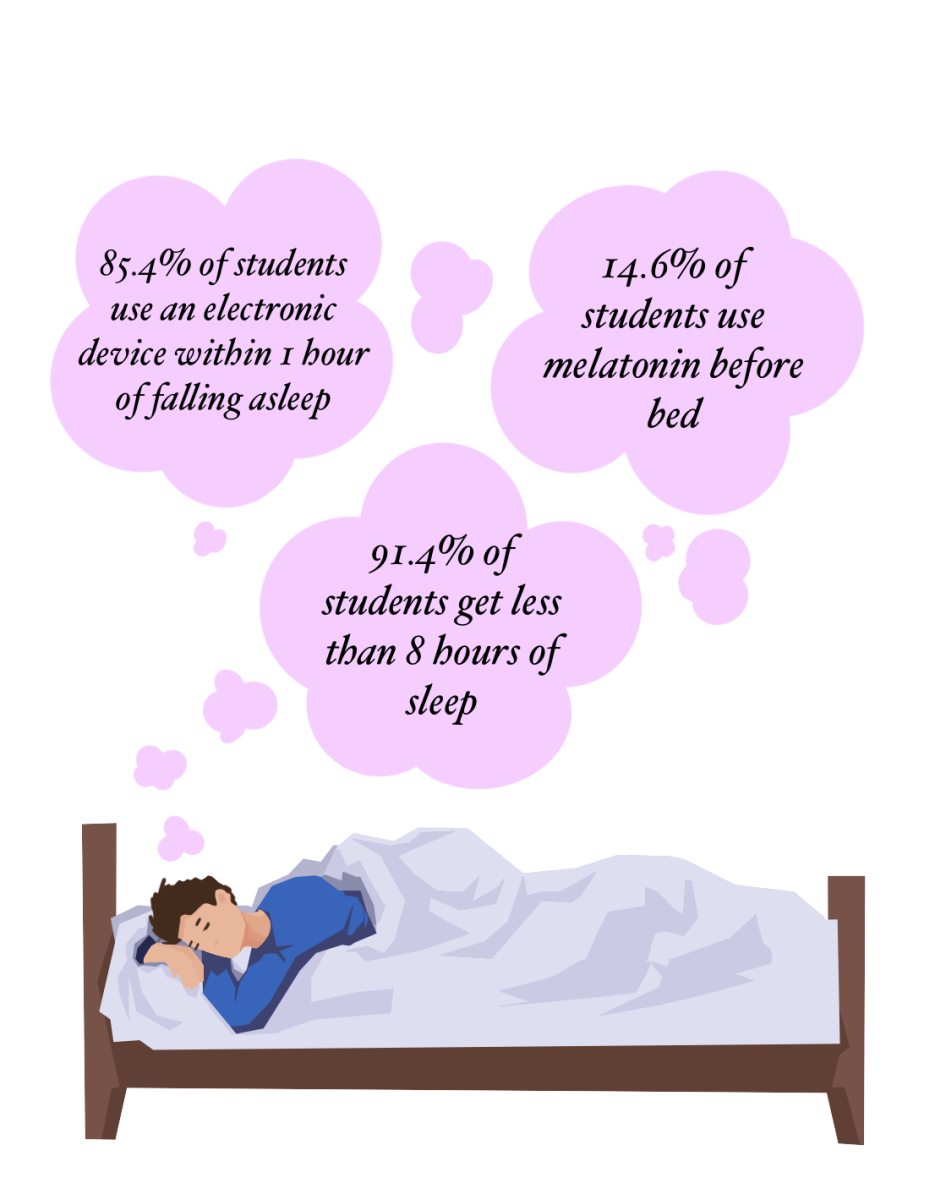
There is an epidemic raging across the United States, and Trinity is not an exception. In a survey of 185 students, a little over 91% reported getting less than the nationally recommended 8-10 hours of sleep. While many students perceive this lack of sleep as a measure of success, sleep deprivation is associated with many negative health outcomes, from lack of focus to significant mental health complications. Going to bed earlier may seem like a simple solution, but this is easier said than done.
Genetics are responsible for up to 50% of the human chronotype, or the natural tendency to sleep or wake at a particular time, according to the Saxena Lab at Harvard. A person’s chronotype is responsible for their circadian rhythm.
“The circadian rhythm is your body’s internal clock … based on a 24-hour cycle,” biology teacher Bryan Moretz said. “It’s something that we’ve evolved over time to help protect us from the environment and make sure that we’re functioning enough to survive, but also getting enough rest to recover.”
Age is another uncontrollable influencer of circadian rhythm as it causes a person’s chronotype to shift over time. Children naturally have a chronotype favoring the morning, making them early birds, until adolescence, when their chronotype gradually shifts in favor of the evening, peaking at 19 years old. Then, as a person ages, the chronotype gradually shifts earlier again. Because of this, teenagers are typically night owls by nature, making it difficult for them to fall asleep and wake up early.
While it is natural for teens to struggle with an early bedtime, there are some lifestyle choices that only exacerbate the problem.
“Light is the biggest thing that can influence your circadian rhythm,” Moretz said. “Exposing yourself to light anytime as it gets darker, especially as you get closer to bedtime, is negatively impacting your sleep cycle and that circadian rhythm.”
Light, especially blue light from computers, phones and other electronics, suppresses melatonin and shifts circadian rhythms by up to three hours, according to Harvard Health. It is recommended that exposure to blue light be limited within one to two hours of bed, but many students rely on their laptops while working at night. Over 85% of Trinity students reported using their laptop or other electronic device within an hour of going to bed. At minimum, avoiding scrolling or other unnecessary electronic use before bed can be beneficial.
Proper light exposure in the morning can also help with regulation by alerting the brain that it is time to wake up. To help with this, certain companies have manufactured lights to mimic the bright morning sunlight.
“I have a 10,000-lux light that I use every morning,” junior Thomas Hoskins said. “It’s really interesting because I normally wake up really early, so I don’t have light in the morning. … (It helps) wake me up in the morning.”
Increasing the light seen in the morning after waking up triggers the release of cortisol, the stress hormone, which increases the brain’s alertness. This is linked with improved mood, greater energy and better sleep quality.
Besides cortisol, melatonin is another naturally produced hormone that serves the opposite role in regulating the circadian rhythm: It tells the body when it is time to sleep. Chronically disrupting the natural release of melatonin, primarily by exposure to light at night, can lead to mood disorders, a weakened immune system and increased risk of neurodegenerative conditions.
Around one in five teens regularly use melatonin supplements in an attempt to fall asleep earlier or increase sleep quality, according to The Washington Post, but oftentimes this is unnecessary.
“In reality, most people don’t need to take melatonin,” Moretz said. “They simply need to get back to a normal schedule. Having a normal schedule will really help you in the long run produce the correct amount of melatonin, so you don’t have to rely on melatonin (supplements) later on.”
In a recent study from the American Heart Association, long-term melatonin use (one year or longer) was associated with an increased risk of heart failure and death. In addition, the body can develop a psychological dependence on melatonin, in which a person believes that they cannot sleep without the supplement.
In middle school, junior Ava Lieb started taking melatonin to make falling asleep easier.
“I took (melatonin pills) for over a year straight every single night (and) could not fall asleep without it,” Lieb said. “One night, I took the entire bottle to try and fall asleep. … Then I realized that was probably a problem. … I had gotten so used to melatonin … that I didn’t feel tired.”
It may seem like there is no easy solution to the epidemic, because that is the unfortunate truth. Sleep deprivation among teens has been a haunting issue for over a decade, according to Stanford Medicine. However, that does not mean there is nothing that can be done to improve personal sleep quality.
“I don’t use my phone, and I make sure I’m not eating a big meal right before I go to sleep,” Lieb said. “Which is hard, especially for schoolwork, and getting home late from practices and things like that. But it’s what I have to do.”
Over time, working to build a consistent sleep routine can improve focus and memory, reduce the risk of mental health issues and boost athletic performance.
“You need to be able to kind of reset overnight (and) get your hormone levels back to where they should be,” Moretz said. “(That way) you can have a good functional day afterward.”