It’s the season of love, or at least racing hearts, obsessive thoughts and indigestible butterflies. Through that lens, Valentine’s Day seems much less simplistic than Cupid would have you believe. In reality, human feelings are not the result of a lucky shot from a winged cherub, but rather a complicated mix of hormonal messages.
The brain is home to dozens of powerful hormones that control how the human body functions. A smaller portion of these hormones is responsible for the infamous phenomenon of a “crush,” namely norepinephrine, dopamine, serotonin, cortisol and oxytocin.
When a crush develops, all of these hormones increase, except serotonin. Counterintuitively, this “happy hormone” responsible for mood regulation significantly drops during this process. According to a 2023 article by Psychology Today, this decrease is similar to that found in individuals with obsessive-compulsive disorder (OCD), leading to persistent, preoccupying ideas.
“You start developing obsessive thoughts,” biology teacher Emily Massey-Burmeister said. “I think anybody who’s … (had) a crush … would say that they get a little obsessive about that person.”
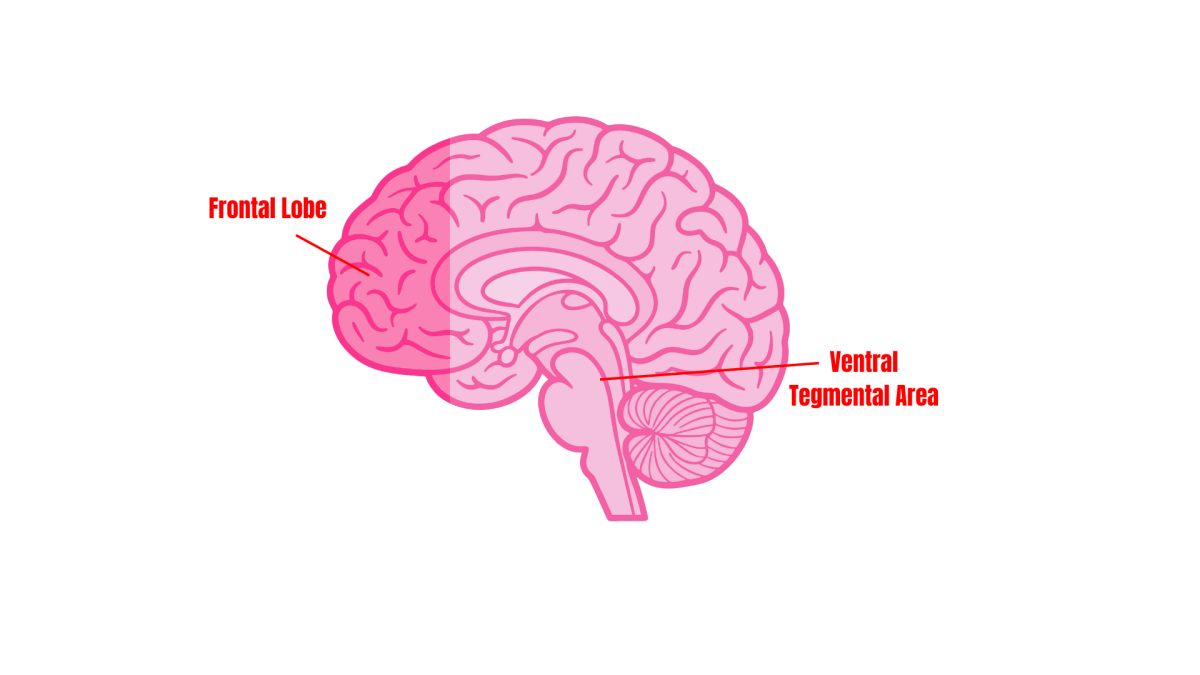
While serotonin is dropping, activity in the frontal cortex of the brain also decreases, further impacting critical thinking and judgment, therefore increasing the tendency to overlook flaws. This is also what makes it difficult to talk to someone you are attracted to.
“I tend to stutter a lot when I’m talking to (someone I have a crush on),” freshman Neel Bhonde said. “Sometimes I have a joke in my mind that I made up (in the) morning and I try to tell her, and it just comes out super wrong.”
Through the release and suppression of these hormones, the chemical composition of the human brain is changed. The ventral tegmental area, the reward system of the brain, is activated and begins producing high levels of dopamine, making the person more impulsive.
“You kind of feel on edge a tiny bit because you’re with somebody that you like,” Bhonde said. “It’s definitely a different feeling. You’re more self-conscious. You want to impress them.”
The strong responses guaranteed by the hormonal reaction of the brain make it rewarding to pursue a connection with another person. A 2015 article by Harvard Medical School explained that this rush of dopamine in the brain has been found to parallel the use of substances such as alcohol in its euphoric effects.
“(This reaction) literally rewires your brain,” Massey-Burmeister said. “When people are like, ‘you need time to heal a broken heart,’ that’s actually kind of true, because you have rewired your brain (due to) these increases in these hormones and these neurotransmitters.”
The human body’s response may seem impractical, but it has intentionally evolved to be this way in an effort to motivate humans to seek connection.
“I would say that evolutionarily speaking, humans, it’s easier to exist as a group than it is to exist as a standalone person,” Massey-Burmeister said. “(It’s) like a safety in numbers type of situation … so there’s this need for you to have closeness with other individuals and kind of build a community.”
While the brain’s chemical reaction to attraction is innate, the question of who the brain may find attractive is a complicated combination of both nature and nurture.
“I think that there is a little bit of the hormone-induced responses, but also it’s a little bit of just learned experience that shapes who you pick as a partner,” Massey-Burmeister said. “There are some reasons why people tend to pick the partners that they tend to pick.”
These reasons naturally vary by person, but one commonality lies in pheromones, or chemical signals that trigger certain reactions from other animals in the same species. These are often released by sweat and have evolved to facilitate the survival and diversity of a species.
“When (the scent) comes from somebody of a close familial connection, you do not like that smell,” Massey-Burmeister said. “But, if it’s coming from somebody that you don’t share a close familial kind of relationship to, you do tend to like the smell of that person a little bit more.”
Outside of these chemical messages, humans tend to gravitate towards other people who share common interests or values, much of which is based on preference.
“I think a big thing for me is how they treat you in conflict,” freshman Lena Chan said. “I think it’s really attractive if they’re gentle and nice during conflict.”
Whatever the reason for that initial attraction, the result is the same: drastic fluctuations in the brain hormones, impelling us to invest in heart-shaped chocolates and candies.
“(Having a crush) is definitely a good feeling,” Bhonde said. “It’s a universal feeling, too. Everyone has it.”