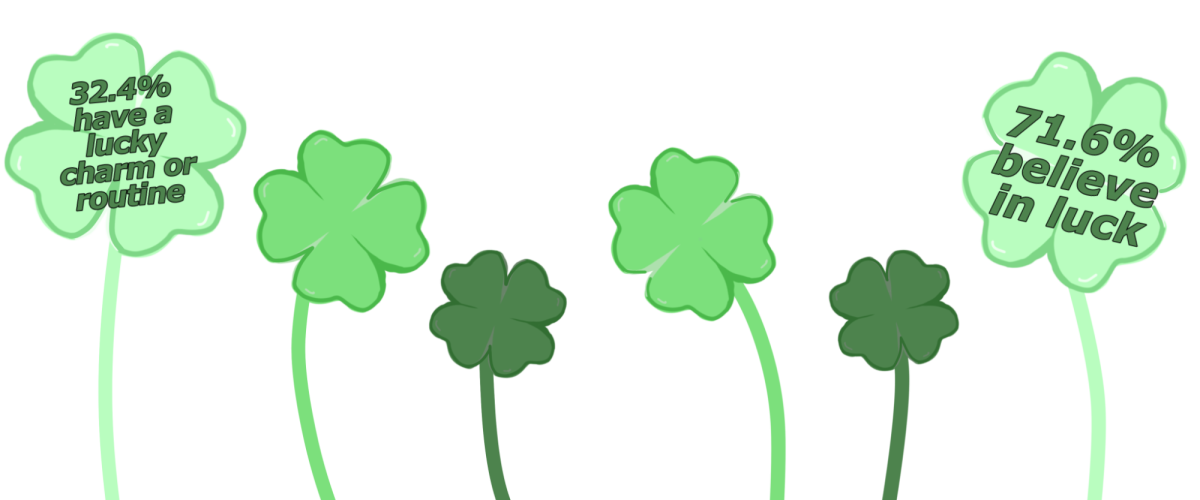
Keychains, necklaces, numbers, music and food — these are a few of the many lucky charms Trinity students report using to make them feel luckier. Out of a survey of 75 upper school students, 71.6%, or 53 students, reported believing in luck, and 32.4%, or 24 students, reported having a specific routine or object that they believe brings them luck.
“I think that luck exists,” junior Campbell Alch said. “I feel like there are just some situations where, if you have a really bad day, then maybe you’re just having bad luck that day. But then if you have a good day, you have good luck.”
The concept of luck, however, is more complex than many often realize. Its origin is rooted in psychology, specifically cognitive bias, in which our expectations shape what we notice and how we respond.
“If you’re really positive and have a positive outlook on life, that’s just gonna bring you more luck,” Alch said. “And if you’re negative, it’s just not gonna bring you good luck.”
People who believe they are lucky are then more likely to pursue challenging opportunities, therefore attracting positive outcomes, while those who believe they are unlucky are more inclined to avoid taking such chances. This cycle reinforces itself; the more you win, the more risks you will take, and the more chances you will have to win again. Conversely, this is true for the cycle of bad luck as well.
Despite this, luck can still serve as a protective measure in the brain.
“(Luck) might (also) be a defense mechanism,” psychology teacher Michael Brown said. “(A person) might be preemptively trying to protect themselves from the emotions they don’t wanna feel if failure does happen, or maybe they don’t wanna feel worried.”
This process of perceiving luck is largely determined by pattern recognition, causing the brain to find meaning and connection between random events.
“(While I was lifting), I wore my hair in a bun once … and I had it in a bun for two lifts, and I missed both of them,” Alch said. “Then I took it out of the bun and made the lifts, so I can never wear a bun weightlifting again.”
Conclusions like these are not rare and can have a drastic impact on performance. According to an article by the Scientific American, while lucky objects or routines don’t have any genuine power, the psychological impacts of believing in them can directly affect outcomes.
“People that are optimistic (and think), ‘I’m lucky and I’m going to heal from this cancer’ … are more likely to go into remission and actually heal,” Brown said. “You’ll heal from wounds quicker, and you’ll beat sickness quicker.”
In contrast, believing that you are an innately unlucky person can have the opposite effect, to the detriment of that person.
“(Believing you are unlucky) is probably going to lead you to a more pessimistic mindset, which then can have other side effects,” Brown said. “Depressive disorders become harder to recover from, (as well as) anxiety disorders. Simultaneously, it can lead to something … (called) learned helplessness.”
This psychological phenomenon occurs when an individual repeatedly endures stressful or traumatic events, and then develops the belief that they are unable to change their situation. In essence, they learn to believe that they are simply an unlucky person.
While a lucky or unlucky object may not possess actual powers, the beliefs reinforced by your thought cycle have impactful, tangible outcomes.
“If you think you’re lucky or if you engage in your routine and that makes you perform better … keep doing it because it’s putting you in a good mindset,” Brown said. “But I think that’s mostly just the mindset you’re putting yourself into and not this extraterrestrial force of luck.”